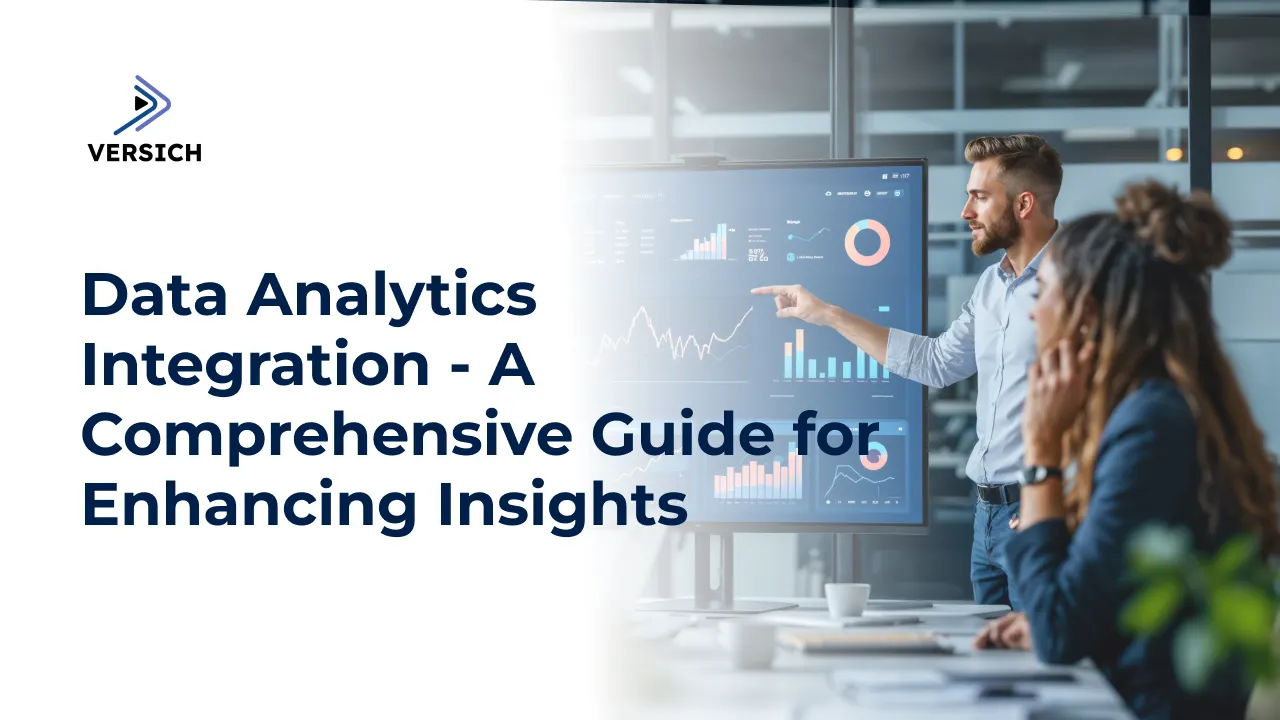
In a world where data is generated at an unprecedented pace, the ability to connect disparate data sources and surface meaningful insights is no longer a competitive advantage. It is a business necessity. At Versich, we work with organisations across industries to unlock the full potential of their data through intelligent, scalable analytics integration. Whether our clients are mid-sized manufacturers trying to understand their supply chain in real time or fast-growing SaaS companies looking to unify customer data from multiple platforms, our approach is always the same: bring the right data together, in the right way, to power decisions that actually move the needle.
This guide offers a comprehensive look at what data analytics integration means in practice, why it matters, the common challenges businesses face, the frameworks and tools that make it work, and the outcomes organisations can expect when they get it right.
What Is Data Analytics Integration
Data analytics integration refers to the process of combining data from multiple sources, systems, and platforms into a unified environment where it can be analysed, visualised, and acted upon. This is not simply about moving data from one place to another. It involves establishing consistent data pipelines, enforcing data quality standards, aligning definitions across business functions, and connecting analytical tools to the systems where data originates.
At Versich, we think of integration as the bridge between raw operational data and strategic intelligence. Our Data and Technology services cover the full spectrum, from data engineering and ETL pipeline design through to advanced analytics, visualisation, and reporting, using modern tools including Python, SQL, Alteryx, Power BI, and Tableau.
Why Data Integration Matters for Business Performance
The case for data analytics integration is both strategic and operational. Our experience working with clients across sectors has shown us that organisations with well-integrated data environments consistently outperform those with fragmented data infrastructure.
When data is integrated, decision-makers have access to a single source of truth. There are no conflicting reports from different departments, no wasted hours reconciling spreadsheets, and no decisions made on outdated numbers. Teams move faster because the data they need is always available and always trustworthy.
Integrated data also enables more sophisticated analysis. When our clients can combine sales performance data with marketing spend data and customer service interactions, they can identify patterns that would be completely invisible if they looked at each dataset in isolation. That kind of cross-functional insight is where real competitive advantage lives.
| Without Integration | With Integration | |
|---|---|---|
| Reporting Speed | Days to compile cross-system reports | Real-time dashboards and automated reporting |
| Data Accuracy | Frequent discrepancies between teams | Single source of truth across the organisation |
| Decision Quality | Reactive, based on partial information | Proactive, based on complete context |
| Cost Efficiency | Manual data handling and reconciliation | Automated pipelines reducing operational overhead |
| Scalability | Ad hoc processes that break under volume | Structured architecture that scales with growth |
Common Challenges in Data Analytics Integration
Despite its importance, data integration is far from simple. Our teams encounter a consistent set of challenges across client engagements, and understanding them is the first step toward addressing them effectively.
Data Silos
Most organisations have built their technology stacks incrementally, adding tools as needs emerged, without a deliberate integration strategy. The result is a patchwork of systems that do not communicate with each other effectively, creating information gaps and forcing manual workarounds.
Data Quality Issues
When data originates from multiple sources, inconsistencies in formatting, naming conventions, and data entry practices create significant problems downstream. A customer who appears as three different records in three different systems is not just a technical problem; it is a business problem that affects marketing, sales, and customer service simultaneously.
Legacy Systems
Many organisations are running core business operations on platforms that were not designed with modern integration in mind. These systems often lack robust APIs, export data in non-standard formats, or impose restrictions on how data can be accessed.
Governance and Ownership Gaps
Even when the technical infrastructure is in place, successful integration requires agreement on data ownership, definitions, and access policies. These conversations span multiple departments and require executive sponsorship to resolve effectively.
| Description | Our Approach | |
|---|---|---|
| Data Silos | Systems operate independently without shared data flows | Architecture design with a unified data layer |
| Data Quality | Inconsistent formats, duplicates, and missing values | Data profiling, cleansing, and validation pipelines |
| Legacy Systems | Older platforms with limited integration capabilities | Custom connectors and ETL processes |
| Governance Gaps | No clear ownership or definitions across departments | Data governance framework implementation |
| Scalability Limits | Integration processes that cannot handle data growth | Cloud-native, scalable pipeline design |
Our Data Analytics Integration Framework
At Versich, we have developed a structured approach to data analytics integration that we apply consistently across client engagements, adapting it to the specific context of each organisation. Our framework is built around five core stages.
Stage 1: Discovery and Assessment
Before any technical work begins, we work closely with our clients to understand their current data landscape, business objectives, and integration priorities. This includes mapping all existing data sources, understanding how data flows today, identifying gaps and pain points, and establishing a clear picture of what success looks like.
Stage 2: Architecture Design
With a clear understanding of the current state and the target state, we design the integration architecture that will connect data sources, establish transformation rules, and feed the analytical layer. We prioritise designs that are scalable, maintainable, and aligned with the organisation's broader technology strategy.
Stage 3: Pipeline Development
Our teams build the data pipelines that extract data from source systems, transform it according to agreed business rules, and load it into the destination environment. We build with reliability and observability in mind, so our clients always know what is happening in their data flows.
Stage 4: Analytics Configuration and Visualisation
With clean, integrated data in place, we configure the analytical tools that our clients will use to generate insights. This includes building dashboards, reports, and models tailored to the specific needs of different user groups within the organisation.
Stage 5: Enablement and Ongoing Support
We work with our clients to ensure their teams understand how to use the integrated analytics environment effectively, and we provide ongoing support to adapt and extend the solution as their needs evolve.
Our Data and Technology Services
Our end-to-end Data and Technology services are designed to take businesses from raw, siloed data to actionable intelligence. We leverage a modern toolset including Python, SQL, Alteryx, Power BI, and Tableau to deliver custom solutions at every layer of the data stack.
Data Engineering and Pipeline Design
We design and build robust data pipelines that move data reliably from source systems into centralised environments. Whether our clients are working with structured relational databases, semi-structured API outputs, or unstructured files, we build the infrastructure to handle it all.
Data Warehousing and Database Architecture
We architect and implement scalable data warehouses using platforms such as Azure Synapse, Snowflake, and BigQuery. Our designs prioritise query performance, cost efficiency, and long-term maintainability, so our clients are not locked into an architecture that cannot grow with them.
Database Cleansing and Quality Management
Poor data quality is one of the most common barriers to effective analytics. Our data cleansing services identify and resolve duplicates, inconsistencies, and gaps across source systems, delivering a clean, trusted dataset as the foundation for analysis.
Advanced Analytics and Reporting
With clean, integrated data in place, we build the analytical layer that turns it into insight. From interactive Power BI dashboards to custom Python-based models and Alteryx workflows, we build reporting solutions that give business users real-time visibility into the metrics that matter most.
Training and Professional Services
We specialise in training Finance and Data teams to unlock the power of their data. Our hands-on approach ensures that your team not only understands the tools but also knows how to apply them for actionable results and business improvement.
NetSuite and Power BI Integration: Connecting Finance and Analytics
One of the most impactful integration scenarios we work on regularly is connecting NetSuite with Power BI. When these two systems are connected effectively, organisations gain the ability to visualise and analyse their financial and operational data in ways that NetSuite's native reporting cannot provide. Learn more about how we approach this on our NetSuite and Power BI Integration Services page.
Finance teams can build dynamic, interactive dashboards that allow them to drill down from high-level P&L summaries into individual transaction details in seconds. Operations teams can monitor inventory levels, purchasing trends, and fulfilment performance in real time. Executives can track the KPIs that matter most to them without waiting for end-of-month reports.
| Data Source in NetSuite | Power BI Output | |
|---|---|---|
| Revenue Analysis | Sales orders, invoices, revenue schedules | Revenue trend dashboards with period comparisons |
| Cash Flow Monitoring | AP/AR transactions, payment records | Rolling cash flow forecasts and ageing reports |
| Inventory Optimisation | Item records, warehouse data, purchase orders | Stock level alerts and reorder point analysis |
| Budget vs Actuals | GL accounts, budget records, journal entries | Variance reports and budget tracking dashboards |
| Customer Profitability | Customer records, sales, service costs | Customer-level P&L and segmentation analysis |
Power BI Consulting: Getting More from Your Analytics Investment
Power BI is a powerful platform, but many organisations that have invested in it are not realising its full potential. This is where our Power BI Consulting Services make a material difference. We help organisations move from ad hoc Power BI usage to a governed, scalable, enterprise-grade analytics capability.
Our Power BI consulting work spans semantic model design, dashboard and report development, row-level security, governance, and deployment pipelines. We also work with organisations migrating to Power BI from other tools, helping them preserve the analytical logic they have built over years while taking advantage of Power BI's capabilities.
| What We Deliver | |
|---|---|
| Semantic Model Design | A well-structured, high-performance data model that serves the whole organisation |
| Dashboard and Report Development | Purpose-built, intuitive reports aligned to user needs and business KPIs |
| Data Governance and Security | Role-based access controls, certification workflows, and usage monitoring |
| Performance Optimisation | Faster load times, efficient DAX measures, and optimised data refresh cycles |
| Training and Enablement | Practical training that builds internal capability and reduces reliance on external support |
Choosing the Right Integration Tools and Technologies
Our approach is to start with the requirements, not the tools. We assess the volume and velocity of data involved, the complexity of transformations required, the latency expectations of the business, and the internal skills available to manage the solution over time.
| Examples | Primary Role | |
|---|---|---|
| Data Warehousing | Azure Synapse, Snowflake, BigQuery | Centralised storage and compute for analytical data |
| Data Integration / ETL | Azure Data Factory, Fivetran, Talend | Moving and transforming data between systems |
| Business Intelligence | Power BI, Tableau, Looker | Visualisation, reporting, and self-service analytics |
| Data Quality Tools | Informatica, dbt, Great Expectations | Profiling, validation, and cleansing |
| ERP and Source Systems | NetSuite, SAP, Salesforce, Dynamics 365 | Origin of core business operational data |
Best Practices for Successful Data Analytics Integration
Align on Business Outcomes First
The most technically elegant integration in the world delivers no value if it does not serve a clear business purpose. We always start by understanding what decisions our clients need to make, what questions they are trying to answer, and what outcomes they are working toward.
Invest in Data Quality from the Start
It is always cheaper and faster to get data quality right early. We build data quality checks and validation rules into our pipelines from the beginning, not as an afterthought.
Design for the End User
Analytics tools that are not used do not deliver value. We involve end users in the design process, test our dashboards and reports with real users before they go live, and iterate based on feedback.
Build Governance In from the Start
Data ownership, access controls, and quality standards need to be established early and maintained consistently. We help our clients establish the governance frameworks that keep their integrated analytics environment reliable and trustworthy over time.
Plan for Ongoing Evolution
Data needs change, source systems change, and business priorities change. The best integrations are designed to adapt. We build with extensibility in mind and provide documentation and support to help our clients manage and extend their solutions confidently.
Measuring the Success of Your Data Analytics Integration
Investing in data analytics integration should deliver measurable outcomes. We work with our clients to define and track metrics across two categories: operational metrics reflecting the health of the integration itself, and business metrics reflecting the value it delivers.
| Example Metrics | Why It Matters | |
|---|---|---|
| Data Freshness | Time from source event to availability in analytics | Ensures decisions are based on current information |
| Data Quality | Completeness, accuracy, and consistency scores | Builds trust in the analytical output |
| Pipeline Reliability | Successful load rate, error frequency | Ensures continuity of analytical operations |
| User Adoption | Active users, report views, self-service usage | Reflects the real-world value being delivered |
| Business Impact | Report time saved, forecast accuracy, revenue effects | Connects integration investment to business outcomes |
Conclusion
Data analytics integration is one of the highest-value investments an organisation can make in its data capability. When done well, it transforms fragmented, siloed information into a coherent, trusted foundation for insight and decision-making.
At Versich, we have built our practice around delivering this value for our clients. From our end-to-end Data and Technology services to specialist, we bring the technical expertise, industry knowledge, and delivery rigour that successful integration requires.
If your organisation is ready to unlock the full potential of its data, contact us and our team will be in touch to arrange a consultation.