Odoo Implementation Services

Build an Odoo ERP environment around the way your business actually works.

Implementing Odoo is more than installing an ERP and turning on a few modules. It involves understanding your existing processes, configuring the right applications, moving your data, connecting the systems you already use, and preparing your teams to work effectively in the new environment.

At Versich, our Odoo implementation services take a business-first approach. We assess how your organization operates, identify where processes can be improved, and design an Odoo ERP environment that supports your current requirements without limiting future growth.

Odoo Implementation Services

Why Odoo Implementation Matters

Odoo implementation is more than installing and configuring ERP applications. A structured implementation ensures the system reflects your business processes, data, teams, and future growth.

 Better Process Alignment

Better Process Alignment

Configure Odoo around your actual workflows instead of forcing teams to work around the system. This helps standardize processes across departments and reduces unnecessary workarounds.

Less Manual Work

Less Manual Work

Connect automation, workflows, and integrations to reduce repetitive tasks. This can help teams spend less time moving information between spreadsheets and disconnected applications.

Higher User Adoption

Higher User Adoption

When Odoo reflects employees’ responsibilities and day-to-day processes, it becomes easier for teams to understand and use. Proper training and role-based workflows also reduce resistance to the new ERP system.

 A Scalable ERP Foundation

A Scalable ERP Foundation

Build an Odoo environment that can adapt as your business grows. New applications, integrations, automation, and custom functionality can be introduced as operational requirements become more complex.

What Is Odoo Implementation?

What Is Odoo Implementation?

Odoo implementation is the process of configuring and deploying Odoo ERP to support a company's specific business processes and operational requirements. A successful implementation involves deciding which Odoo applications your business needs, configuring workflows and permissions, migrating existing data, integrating third-party systems, testing critical processes, training users, and preparing the system for go-live.

The objective is to configure Odoo so that it supports the way your organization operates while creating opportunities to improve inefficient processes.

Ready to Build an Odoo ERP for Your Business?Ready to Build an Odoo ERP for Your Business?

Our Odoo Implementation Services

Every business has different processes and priorities, so Odoo implementation should be tailored to its needs. At Versich, our Odoo implementation services cover the full ERP lifecycle, from requirements analysis and configuration to customization, data migration, integrations, user training, go-live, and ongoing support.

Business Analysis & Requirements Gathering

Business Analysis & Requirements Gathering

A successful Odoo ERP implementation starts with understanding the business before configuring the software. Our Odoo consultants work with key stakeholders to examine existing processes, operational challenges, approval structures, reporting needs, and long-term objectives.

Odoo Solution Design & Configuration

Odoo Solution Design & Configuration

Our Odoo implementation consultants design the ERP environment around your operational processes, configuring modules, permissions, workflows, dashboards, and reports based on discovery findings, focused on a setup that stays flexible as your business grows.

Odoo Customization

Odoo Customization

Our Odoo customization services extend the platform where standard configuration can't deliver the functionality you need, covering workflows, approval processes, dashboards, and reports. We first assess whether standard Odoo functionality can address the need before recommending custom development.

Odoo Integration

Odoo Integration

Our Odoo integration services connect Odoo with the applications your business already depends on, assessing APIs, data requirements, and existing processes to reduce duplicate entry and keep systems working together smoothly.

Odoo Data Migration

Odoo Data Migration

Our Odoo data migration services help businesses prepare, map, migrate, and validate data from spreadsheets, legacy systems, or previous Odoo versions, treating migration as part of the implementation rather than a separate task.

Odoo Testing & Quality Assurance

Odoo Testing & Quality Assurance

An ERP system can look correctly configured and still fail under real-world workflows, which is why testing is core to our Odoo implementation services. Before go-live, we test the environment against business requirements and support user acceptance testing (UAT), resolving issues before production deployment.

Odoo Training & User Adoption

Odoo Training & User Adoption

Our Odoo training services provide practical, role-based training built around the real workflows your teams will use day to day, helping improve adoption and reduce confusion during the transition to the new system.

Go-Live & Post-Implementation Support

Go-Live & Post-Implementation Support

We support the transition into production, help resolve early adoption issues, and provide technical guidance where needed. Our ongoing Odoo support helps you introduce new capabilities and refine processes without rethinking your entire ERP environment.

Odoo Modules We Implement

Odoo's modular architecture allows businesses to implement the applications that support their current operations and expand their ERP environment as their needs evolve. As part of our Odoo implementation services, we help organizations select, configure, integrate, and customize the Odoo modules that best align with their business processes.

Odoo Accounting

Odoo Accounting

We implement and configure Odoo Accounting to help businesses manage core financial processes from a centralized platform. This includes invoicing, vendor bills, payments, expenses, bank reconciliation, financial reporting, and other accounting workflows.

Odoo CRM

Odoo CRM

Our Odoo CRM implementation helps businesses centralize customer information and manage the entire sales pipeline in one place. We configure lead and opportunity management, sales activities, pipeline stages, and reporting according to your sales processes, while helping management monitor pipeline performance and customer engagement.

Odoo Sales

Odoo Sales

We implement Odoo Sales to streamline the process from quotation to sales order and invoicing, covering quotations, pricing, products, sales orders, and approval processes. When integrated with CRM, inventory, and eCommerce, Odoo Sales creates a connected order process that reduces manual handoffs between departments.

Odoo Inventory

Odoo Inventory

Our Odoo Inventory implementation helps businesses gain greater control over stock, warehouses, and product movements. We configure operations such as receipts, deliveries, internal transfers, replenishment, stock adjustments, and inventory valuation based on your operational requirements.

Odoo Purchase

Odoo Purchase

We implement Odoo Purchase to help businesses manage procurement from supplier selection through purchasing and receiving, including vendor management, requests for quotation (RFQs), purchase orders, receipts, and approval workflows.

Odoo Manufacturing

Odoo Manufacturing

Our Odoo Manufacturing implementation supports businesses that need greater control over production planning. We configure workflows including bills of materials (BoMs), work orders, production orders, and quality processes, often connected with inventory, purchasing, and maintenance for a more complete view of production.

Odoo Point of Sale (POS)

Odoo Point of Sale (POS)

We implement Odoo Point of Sale to connect retail transactions with the rest of the ERP environment, configuring POS to work with products, inventory, customers, and accounting. An integrated Odoo POS environment helps centralize transaction data. and improve visibility across retail operations.

Odoo eCommerce

Odoo eCommerce

Our Odoo eCommerce implementation connects online selling with core business operations, configuring workflows for products, customers, orders, payments, inventory, and fulfillment. Connecting the online storefront with Odoo ERP reduces manual order processing and keeps information consistent.

Odoo Helpdesk

Odoo Helpdesk

Our Odoo Helpdesk implementation helps businesses centralize customer support requests and service workflows, configuring ticket management, support teams, and reporting according to your support processes. When connected with CRM, Helpdesk provides a more complete view of customer interactions and ongoing service needs.

Common Odoo Implementation Challenges

An Odoo implementation can deliver significant operational improvements, but the outcomedepends heavily on how the project is planned and executed. Many implementation problems donot originate from the Odoo platform itself. They come from unclear requirements, poor datapreparation, unnecessary customization, disconnected systems, or insufficient user preparation.Understanding these challenges early allows businesses to address them before they becomeexpensive problems during deployment.

01

Unclear or Changing Requirements

If requirements are incomplete, teams may configure workflows based on assumptions rather than actual business needs. Requirements can also change during implementation as stakeholders gain a better understanding of what the Odoo ERP environment can support. A structured discovery and planning process helps distinguish essential requirements from preferences and prevents the project from continually expanding beyond its agreed scope.

02

Poor-Quality or Inconsistent Data

Data migration is often more complicated than simply exporting information from one system and importing it into another. Migrating poor-quality data into Odoo simply transfers the problem into the Odoo environment. Effective Odoo data migration therefore requires assessment, cleansing, mapping, transformation, test migrations, validation, and final verification before the production database is populated.

03

Unnecessary Customization

Customization is appropriate when there is a genuine business requirement that cannot be addressed effectively through configuration. Excessive customization can increase development costs, testing requirements, maintenance effort, and complexity when the system is upgraded.

04

Complex Third-Party Integrations

Businesses may already depend on third-party applications. As the number of integrations increases, testing and monitoring become increasingly important. Integration that works in isolation may still cause problems when it interacts with other business processes.

05

Insufficient Testing

Testing only whether individual Odoo applications work is not enough. Real business processes often cross multiple applications and departments. Effective Odoo testing should cover realistic end-to-end scenarios, user permissions, integrations, migrated data, automated actions, custom functionality, and exception cases before go-live.

How Odoo Implementation Supports Business Growth

Implementing Odoo is not simply about replacing several applications with one ERP system. The bigger opportunity is to create a more connected operating environment where business information, workflows, and teams can work together more effectively.

Unified Business Operations

Unified Business Operations

Odoo connects CRM, sales, accounting, inventory, purchasing, and manufacturing into one ERP environment. Instead of separate records across multiple apps, teams share information across processes, reducing silos and giving a clearer view of the organization.

Modular Growth

Modular Growth

Odoo's modular structure means businesses don't need every application at once. A company might start with CRM, Sales, and Accounting, then add Inventory, Manufacturing, or eCommerce as needs grow, letting the ERP evolve with the business.

Better Operational Visibility

Better Operational Visibility

Connected data gives managers a clearer view of operations, making it easier to spot issues, monitor performance, and make decisions based on current information.

Scalability & Adaptability

Scalability & Adaptability

Odoo scales with your business as transaction volumes, teams, and locations grow. You can expand the environment, add workflows, and integrate new systems without replacing the platform, giving your organization a stronger foundation for growth while keeping processes connected.

Flexible Business Processes

Flexible Business Processes

Every organization has its own workflows, approval structures, reporting requirements, and operating model. Odoo can be configured to accommodate these differences and, where standard functionality is not sufficient, extended through appropriate customization and development.

Process Automation

Process Automation

Odoo can automate repetitive, rule-based activities across different business processes. Depending on the configuration, this can include notifications, approvals, invoicing, replenishment, follow-ups, and other workflow-driven tasks.

Odoo Implementation for Different Industries

Odoo implementation is not a one-size-fits-all exercise. The applications, workflows, integrations, reporting requirements, and level of customization can vary significantly depending on the industry and business model.

Manufacturing

Manufacturing

We can implement Odoo to connect workflows and provide a more centralized view of production activities, materials, stock levels, purchasing requirements, and operational performance.The implementation can be structured around the organization's production model, supply chain, approval processes, and reporting requirements.

Wholesale & Distribution

Wholesale & Distribution

Distribution businesses depend heavily on accurate inventory, purchasing, warehouse, sales, and logistics processes.Odoo can connect these activities so teams have a more consistent view of stock movement, customer orders, purchasing, suppliers, and warehouse operations.

 Retail & eCommerce

Retail & eCommerce

Retail and ecommerce businesses often operate across several connected channels, making synchronization between sales, inventory, and customers important. We can implement Odoo across POS, eCommerce, CRM, inventory, sales, and accounting workflows to create a more connected retail environment.

 Healthcare

Healthcare

Healthcare organizations often have complex administrative and operational workflows that require careful planning during ERP implementation. Odoo can support areas such as appointments, inventory, procurement, billing, HR, and administrative operations, depending on the organization's requirements.

 Professional Services

Professional Services

Professional services businesses need visibility across clients, projects, employees, billable activities, expenses, and financial operations. Odoo can connect CRM, project management, timesheets, invoicing, expenses, and accounting to help client-facing and internal teams work from a more coordinated environment.

 Construction

Construction

Construction companies typically manage multiple projects alongside procurement, equipment, inventory, labor, timesheets, and financial activities. Odoo can bring these workflows together to provide greater visibility at both project and organizational levels.

Our Odoo Implementation Process

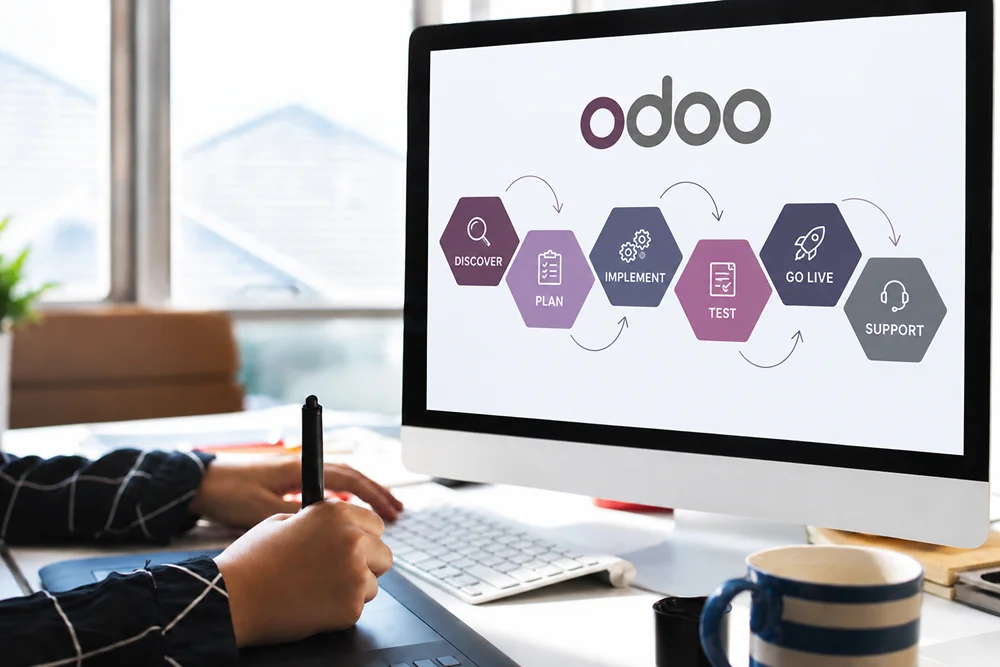
A successful Odoo ERP implementation needs a structured delivery process that connects business requirements, system design, implementation, testing, and user adoption. At Versich, our Odoo implementation services take a phased approach so that decisions made early in the project support a stable and scalable Odoo environment later. Each stage builds the previous one, giving your team clear visibility into what is being implemented, why it is needed, and how it will support day-to-day operations.

Discovery & Business Analysis

Discovery & Business Analysis

We begin by understanding how your business operates today before deciding how Odoo should be configured. Our team works with relevant stakeholders to understand existing workflows, operational challenges, business objectives, current technology, and the areas where your organization needs greater efficiency or visibility.

Solution Design & Implementation Planning

Solution Design & Implementation Planning

We determine which Odoo applications are needed, what standard configuration can handle, and where customization is necessary. This includes identifying systems to integrate, data to migrate, and user roles, with testing and go-live requirements built into the roadmap from the start.

Odoo Environment Setup & Development

Odoo Environment Setup & Development

Standard Odoo functionality is configured first, covering applications, company settings, user access, workflows, and reports. Where configuration alone can't meet requirements, we add targeted custom development, focused on genuine business needs and long-term maintainability.

Data Migration & System Integration

Data Migration & System Integration

We prepare data from spreadsheets, legacy ERP systems, databases, or other business applications before it enters Odoo, cleaning, mapping, and validating records against migration requirements. At the same time, we implement the integrations needed to connect Odoo with your broader tech environment.

Testing & User Acceptance

Testing & User Acceptance

Testing covers user permissions, business rules, integrations, migrated data, and custom functionality across key workflows. Users then complete user acceptance testing (UAT) to validate real scenarios before launch, with any issues resolved and retested prior to go-live.

Training & Go-Live

Training & Go-Live

Training is tailored to each user role, focused on how Odoo fits into daily responsibilities rather than just feature locations. As the system goes live, we support the transition and help resolve early adoption issues to minimize disruption.

Optimization & Ongoing Support

Optimization & Ongoing Support

Implementation doesn't end at go-live. As teams use the system in real conditions, we help review workflows, resolve issues, improve integrations, and introduce new capabilities where they add genuine value.

What Can Affect an Odoo Implementation Timeline?

Several factors can influence how quickly an Odoo ERP implementation can move from planning to production. The number of applications is one consideration, but it is not the only one. The complexity of the underlying business processes often has a greater impact.

Business Process Complexity

Business Process Complexity

Highly specialized workflows may require additional configuration, testing, or customization. A company with straightforward sales and accounting processes will generally follow a different implementation path than a manufacturer managing production planning, quality checks, procurement, and multiple approval levels.

Data Migration Requirements

Data Migration Requirements

Clean, structured data is easier to migrate than information spread across spreadsheets, legacy systems, or inconsistent databases. The volume of records, number of data sources, duplicates, and required transformations all need to be considered before migration begins.

 Integration requirements

Integration requirements

Connecting Odoo to ecommerce platforms, payment providers, CRM systems, or other applications requires understanding APIs, authentication, data mappings, and error handling. The more systems involved, the more integration testing is typically needed.

Customization requirements

Customization requirements

Customization can extend the project when standard Odoo functionality doesn't adequately support a genuine business requirement, since custom workflows, reports, or modules need to be designed, tested, and maintained.

The right implementation timeline is one that allows sufficient time for requirements gathering, configuration, data migration, integration, testing, training, and validation without rushing critical decisions simply to meet an arbitrary launch date.

Odoo Implementation Timeline Expectations

Odoo Implementation Timeline Expectations

Every Odoo implementation is different, so both cost and delivery time depend on the scope of the project. The number of Odoo modules, complexity of your business processes, data migration requirements, third-party integrations, customization, number of users, and deployment structure can all influence the final investment and timeline.

Basic Odoo Setup

  • A basic Odoo implementation is suitable for smaller teams that need a focused deployment using standard Odoo functionality. This may involve configuring a small number of core applications, setting up users and permissions, defining basic workflows, and making limited configuration changes with minimal customization or integration requirements.

Mid-Scale Odoo Implementation

  • A mid-scale Odoo ERP implementation typically involves several connected applications, more detailed workflow configuration, migration of existing business data, moderate customization, third-party integrations, testing, and role-based user training. The additional coordination between departments and systems generally requires more planning and validation before the environment is ready for production.

Complex Odoo ERP Implementation

  • Larger Odoo projects can take three months or longer when the implementation involves multiple companies or entities, complex business processes, extensive customization, multiple third-party integrations, large-scale data migration, advanced reporting, or a phased rollout across the organization.

Our Success Stories

A successful Odoo implementation should solve real operational problems, not simply result in a new software deployment.

5.0
Full starFull starFull starFull starFull star

We needed our sales and inventory processes to work together instead of being managed separately. Connecting these workflows through Odoo has made order management much more straightforward for our team

Sophie Bennett

E-commerce Director, Willow & Finch Commerce
5.0
Full starFull starFull starFull starFull star

Managing multiple warehouse locations was becoming increasingly difficult as we grew. Odoo has given our team a much clearer picture of inventory and order activity, making it easier to coordinate operations across locations

James Anderson

Supply Chain Director, Northstar Distribution
5.0
Full starFull starFull starFull starFull star

The biggest improvement has been having a clearer view of our day-to-day operations. Our teams can access the information they need without relying as heavily on separate systems and manual coordination

Emily Carter

Operations Manager, Havenbrook Health
5.0
Full starFull starFull starFull starFull star

Before Odoo, our production and inventory teams were working with information spread across different processes. Having everything connected has made it much easier to track what is happening across the business and respond when something needs attention

Daniel Whitmore

Operations Director, Ironvale Manufacturing
5.0
Full starFull starFull starFull starFull star

Managing projects, procurement, and equipment across multiple sites had become increasingly difficult. Versich implemented Odoo to improve visibility into project progress, inventory, and resource allocation, helping our teams make better decisions.

Robert Hayes

Project Director, Stonebridge Developments
5.0
Full starFull starFull starFull starFull star

As our operations expanded, Versich helped us gain real-time visibility into projects, inventory, and resource allocation. Communication has improved, and we can now make better decisions using accurate information.

Sarah Bennett

Head of Administration, Clearview Healthcare Services
5.0
Full starFull starFull starFull starFull star

Versich took the time to understand our workflows and configured Odoo around our operational needs. Automation has reduced manual coordination and given our team access to the information they need in one place.

James Wilson

Production Manager, Oakridge Manufacturing Company
5.0
Full starFull starFull starFull starFull star

Versich helped us implement Odoo without disrupting our production process. The transition was smooth, and we now have better inventory tracking, production visibility, and reporting.


Michael Carter

Operations Lead, Bluecrest Trading Co
5.0
Full starFull starFull starFull starFull star

As our business grew, managing inventory, procurement, and sales became more difficult. Versich implemented Odoo around our workflows, improving collaboration and giving us better control over daily operations.”

Daniel Reed

Operations Manager, Northvale Company

Explore Our Complete Odoo ERP Solutions

Why Choose Versich for Odoo Implementation Services

Choosing an Odoo implementation partner is about more than finding a team that knows how to configure the software. The right partner should understand how Odoo needs to fit into your existing processes, technology environment, and long-term business plans.

Business-First Approach

Business-First Approach

We start by understanding the business before deciding how the technology should be implemented. We look at your workflows, operational challenges, users, existing systems, and objectives.This gives the implementation a clear business purpose from the beginning.

Tailored Implementation

Tailored Implementation

We tailor the implementation around your processes, users, data, integrations, reporting requirements, and growth plans. This allows the resulting Odoo environment to reflect how your organization actually operates.

 End-to-End Delivery

End-to-End Delivery

We can support the implementation lifecycle from discovery and solution planning through environment setup, customization, data migration, integration, testing, training, go-live, and post-implementation support. This gives your organization a consistent implementation partner throughout the project.

Practical Customization

Practical Customization

We prioritize configuration. Where a genuine business requirement cannot be addressed adequately through standard functionality, we can introduce targeted customization or development.This approach helps balance business flexibility with long-term maintainability.

  Integration Expertise

Integration Expertise

We can help connect Odoo with ecommerce platforms, CRM systems, accounting tools, payment platforms, logistics systems, and custom applications using appropriate integration approaches. This creates a more connected environment and reduces unnecessary manual movement of information between systems.

BLOGS & NEWS

Our Latest Blogs

08 Sep, 2026 by Chine Okoli

How Odoo Workflow Customization Improve…

As a business grows, the way work moves between teams becomes harder to manage. A sales request may need approval before it reaches finance, a purchas
Read More
08 Sep, 2026 by Samuel Afolabi

Odoo Community or Enterprise: How to Ch…

Once you decide that Odoo is the right ERP platform for your business, the next question is often Odoo Community or Enterprise ? Both editions are bui
Read More
07 Sep, 2026 by Sharanya R

5 Odoo Integrations That Help Growing B…

Odoo can manage a lot of business activity in one place, but growing businesses rarely run on one system alone. Odoo ERP brings areas such as accounti
Read More
View More Blogs

Frequently Asked Questions

What are Odoo implementation services?

Odoo implementation services cover the process of planning, configuring, customizing, integrating, testing, and deploying Odoo ERP around a company's specific business requirements. Depending on the project, implementation can also include data migration, user training, go-live support, and ongoing optimization.

How long does an Odoo implementation take?

The timeline depends on factors such as the number of modules, business complexity, data migration requirements, integrations, customization, number of users, and deployment scope. A straightforward implementation may take several weeks, while larger or more complex ERP deployments can take several months. We establish a realistic timeline after assessing your requirements.

Can Odoo be customized for our business?

Yes. Odoo can be configured extensively, and additional customization can be developed where standard functionality does not meet a genuine business requirement. We recommend using standard Odoo functionality where possible and introducing customization where it provides clear value.

Can you migrate our existing data to Odoo?

Yes. We can help assess, cleanse, map, migrate, and validate data from spreadsheets, legacy ERP platforms, databases, or existing Odoo environments. The migration approach depends on the volume, structure, quality, and type of data involved.

Why should we work with an Odoo implementation partner?

An experienced Odoo implementation partner can help translate business requirements into a practical ERP solution, reduce implementation risks, manage data migration and integrations, support testing and training, and provide assistance after deployment. The right partner can also help prevent unnecessary customization and design an Odoo environment that remains manageable as your business grows.

Should we implement all the Odoo modules at once?

Not necessarily. Implementing every available module at once can add unnecessary complexity and make adoption harder. A better approach is to prioritize the modules that address your most important operational needs, establish a stable core system, and introduce additional modules as your processes and requirements evolve.

How do you handle Odoo implementation when our business processes are complex?

We start by mapping the actual workflows, dependencies, approval rules, data requirements, and system interactions rather than forcing existing processes into a standard setup. we determine what Odoo can handle through configuration, where customization is justified, and which processes require integrations or automation.

What happens after Odoo goes live?

Post-go-live support can include troubleshooting, user assistance, performance monitoring, workflow adjustments, and further optimization. As your business changes, we can also help add modules, refine existing processes, or develop new integrations and customizations to keep Odoo aligned with your needs.