A useful business app used to take months to build and a real budget to justify. That is no longer true. AI coding agents can now generate a functional application, one good enough to actually use, in a matter of days. Engineering leaders who built software at global scale are saying so plainly, and anyone who has watched a working tool appear from a few prompts already believes it.
For most people, the takeaway is excitement about how much cheaper software has become. For anyone responsible for a NetSuite investment, there is a sharper and more useful question sitting underneath it. If the interface and the logic on top are now cheap to produce, then what is it that still holds value? What are you actually paying for?
The answer is the part AI did not build and cannot fake. And once you see it clearly, it changes how you should think about your ERP.
What Actually Becomes Cheap, and What Does Not
It helps to separate a business system into layers, because AI is not making all of them cheap at the same rate.
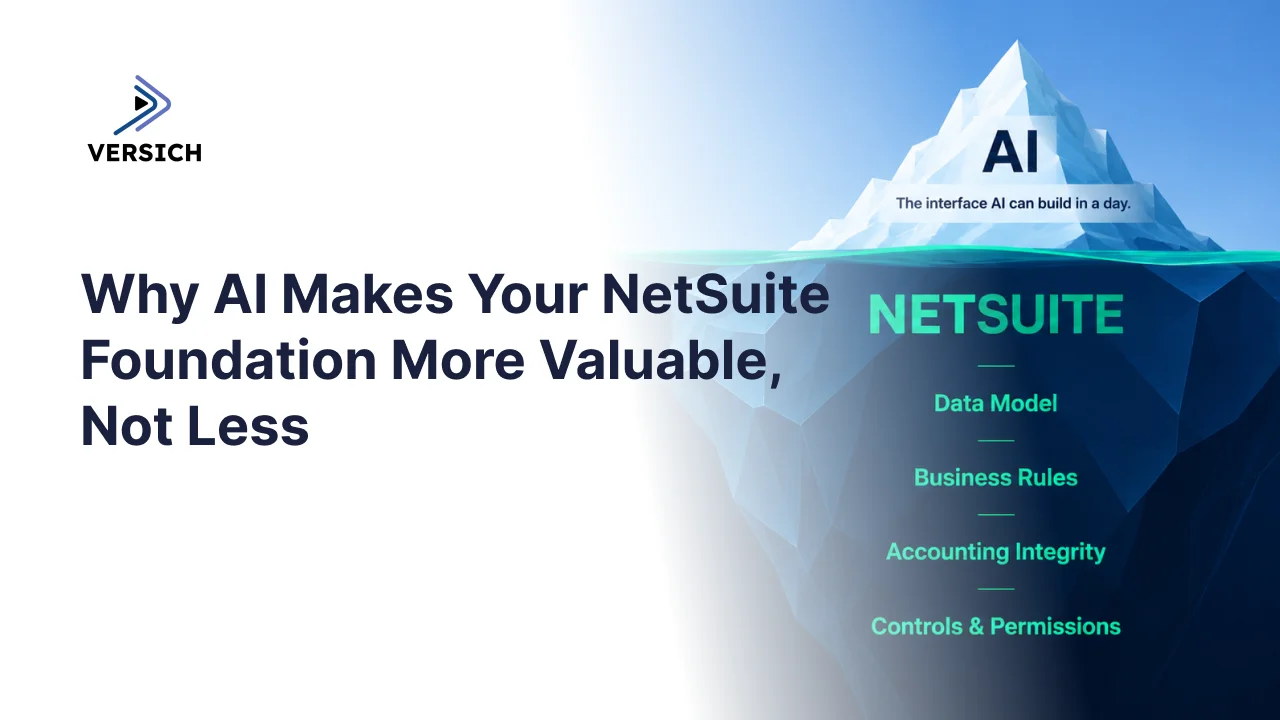
The top layer is the interface, the screens people click through. Below that is the logic, the rules that move data from one state to the next. Below that is the data model, the structure that defines what a customer, an order, an invoice, and a subsidiary are and how they relate. And underneath everything is the control layer, the accounting integrity and permissions that decide what is allowed to be true.
AI is collapsing the cost of the top two layers fast. Generating a screen or a workflow is exactly the kind of well-defined task these tools do well. But the two layers underneath do not get cheap in the same way, because they are not really software problems. They are business modelling problems. Deciding how your business should be represented, what rules protect it, and what must never be allowed to break is judgement work, and judgement does not fall in price just because code does.
So the value does not disappear. It moves. It sinks down to the layers AI cannot generate for you, because those layers encode decisions only your business can make.
Why This Makes NetSuite More Valuable, Not Less
There is a lazy version of the AI conversation that goes like this: if software is cheap to build, then platforms like NetSuite matter less, because you can just build what you want. That gets it backwards.
Strip the native interface away from NetSuite for a moment and look at what remains. You find a coherent data model, a set of transaction relationships, a permissions structure, and a body of accounting logic that has been hardened over decades. Debits equal credits, always. Accrual accounting reflects real economic performance rather than just cash moving around. Inventory subledgers tie purchase orders, receipts, assemblies, and shipments together so that operational reality and financial reality stay connected.
None of that is the screen. All of it is the thing the screen was only ever a window into. In a world where screens are cheap, the window was never the valuable part. The valuable part is the disciplined model underneath, and that is precisely what a serious ERP provides.
This is why the interface-first objections to NetSuite are aging badly. Teams used to reject perfectly good systems because a screen did not fit how they wanted to work. When shaping that screen cost a fortune, the objection carried weight. Now that it does not, the objection loses its force, and attention returns to the only question that was ever durable: is the underlying model sound?
The Chain That AI Cannot Save You From
Here is the part that matters most for anyone running a business on NetSuite, and it has nothing to do with technology.
A healthy business system connects three things in a single unbroken chain. Planning expresses what you intend to do. Operations turn that intention into action, or fail to. Accounting measures what actually happened and confirms whether performance matched intention. When those three are connected, the business has a foundation you can trust and build on, and a system whose data is modelled coherently enough to connect to everything around it. When they are disconnected, you have activity that looks like progress but cannot be verified.
AI does not fix a broken chain. It accelerates whatever it is pointed at. Point it at a disciplined, connected system and it becomes a genuine multiplier. Point it at a fragmented one and it will automate the confusion, move it faster, and scale the disorder along with it. Automation without control is not efficiency. It is just chaos delivered on schedule.
This is the uncomfortable truth beneath the excitement. The organisations that win with AI will not be the ones that adopted the most tools. They will be the ones whose underlying business was modelled clearly enough that automation had something trustworthy to stand on.
Getting a NetSuite Environment Ready for AI
If the value now lives in the model and the controls, then the work that matters is the work of getting those right. In practice that means a few concrete things, none of which AI can do on your behalf.
It means the data model reflects how your business actually operates, not a generic default that everyone quietly works around. It means business rules are made explicit, so the system knows what must be true before a record is allowed to move forward, rather than relying on people to remember. It means exceptions are visible and managed deliberately, instead of being chased manually at month-end. And it means access and accounting controls are sound, so that both people and AI agents act on information that can be trusted. This is the kind of ongoing NetSuite configuration and administration discipline that separates a system you can automate from one you cannot.
Do this work, and an AI agent has something real to help with. It can inspect exceptions, suggest causes, propose next actions, and support a human making the final call, all inside boundaries that keep it from wandering somewhere it should not. Skip this work, and handing an agent access to your ERP is not a productivity gain. It is a liability moving at speed.
The sequence is not optional. A system has to be disciplined before it can be safely automated. That has always been true. AI just raises the stakes of getting it wrong.
Conclusion
The cheapening of software is real, and it is a genuine shift. But it does not make serious business systems less important. It relocates their value to where it was always meant to sit: in the model, the controls, and the accounting truth beneath the surface.
So when you ask what you are paying for in the AI era, the honest answer is that you are no longer paying for screens and you were never really paying for software. You are paying for a business modelled clearly enough that planning, operations, and accounting hold together, and governed well enough that both people and machines can act on it without breaking trust.
That is the work that does not get cheaper. It is also the work that decides whether AI becomes a multiplier for your business or an accelerant for its problems. Getting the foundation right was always the point. AI has simply made it the whole game.