Introduction
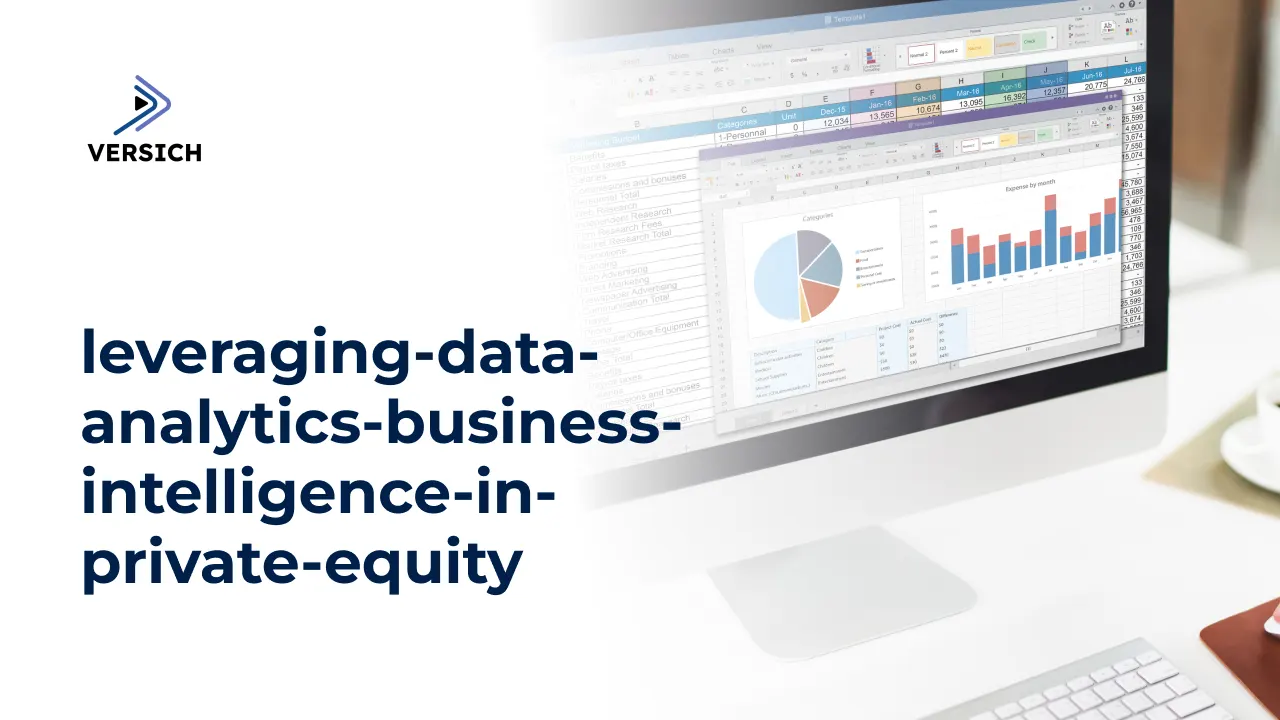
Private equity has always been a numbers driven business, but the numbers that matter most are changing. Deal teams used to win on speed and relationship access. Today, the firms pulling ahead are the ones that can turn portfolio data into decisions faster than their peers. At Versich, we work with PE firms and their portfolio companies to build the data analytics and business intelligence foundations that make this possible, and we have seen firsthand how the right BI strategy changes the way a firm sources deals, monitors performance, and exits investments.
In this article, we look at why data analytics and BI have become core infrastructure for private equity, where the highest value use cases are, and how firms can build a practical roadmap for adoption. We also share what we have learned from helping clients connect ERP, CRM, and operational data into unified reporting environments that hold up to investor and board level scrutiny.
This shift is not unique to the largest mega funds. We work with mid market and lower middle market sponsors just as often, and the pressure to professionalize reporting looks remarkably similar regardless of fund size. Smaller deal teams often feel it more acutely, since they tend to have leaner finance functions covering more portfolio companies with fewer dedicated resources. A well designed analytics environment closes that gap by doing more of the heavy lifting that used to fall on a handful of overstretched controllers and analysts.
Why Data Analytics Matters in Private Equity Today
Private equity firms operate under more pressure than ever to prove value creation, not just claim it. Limited partners want evidence that operational improvements are real and repeatable. Deal teams need to underwrite opportunities faster, often against competitors who are evaluating the same target. And portfolio company leadership teams are expected to report performance on a cadence that traditional finance processes were never built to support.
We find that the firms managing this pressure well share a common trait. They have invested in the data infrastructure and analytics capability to turn raw operational and financial data into something decision makers can actually use. This is not about adding more spreadsheets. It is about building governed, connected data environments and pairing them with business intelligence tools that surface the right metrics to the right people at the right time.
There is also a competitive dimension that is easy to underestimate. In a market where multiple firms are often bidding on the same asset, the team that can model scenarios faster, validate seller provided numbers more rigorously, and present a clearer value creation thesis to its investment committee has a real edge. That speed does not come from working longer hours during diligence. It comes from having repeatable analytical processes and dashboards already built before the deal ever lands on a desk.
The shift is visible across the deal lifecycle:
Deal Stage | Traditional Approach | Data Driven Approach |
Sourcing | Manual screening, network referrals | Predictive scoring models, market signal tracking |
Due Diligence | Static spreadsheets, manual data requests | Connected dashboards, automated data validation |
Value Creation | Quarterly board decks | Real time KPI dashboards, exception based alerts |
Exit Preparation | Last minute data clean up | Continuously audit ready reporting |
Key Use Cases for BI in Private Equity Firms
Business intelligence touches almost every function inside a PE firm and its portfolio companies. We tend to see the strongest early wins in a handful of areas.
- Portfolio performance monitoring, consolidating financials across multiple portfolio companies into a single, comparable view
- Deal sourcing and screening, using data models to rank and prioritize opportunities against a firm's investment thesis
- Operational KPI tracking, giving portfolio company management real time visibility into the metrics that drive valuation
- Cash flow and liquidity dashboards, surfacing risk before it becomes a covenant issue
- LP reporting automation, reducing the manual effort behind quarterly and annual reporting packages
- Exit readiness analytics, keeping financial and operational data clean and defensible well ahead of a sale process
Each of these use cases depends on the same underlying capability: getting data out of disconnected systems and into a structure that supports fast, reliable analysis. This is where many firms get stuck, and it is also where we spend most of our time with clients.
It is worth noting that these use cases tend to reinforce each other once the underlying data foundation is in place. A firm that builds strong operational KPI dashboards for value creation work often finds that the same data model speeds up due diligence on the next acquisition, since the metric definitions, data connections, and reporting templates are already proven. This compounding effect is one of the more underrated benefits of treating analytics as infrastructure rather than as a one off project tied to a single deal or portfolio company.
From Fragmented Data to a Single Source of Truth
Most PE firms do not have a data problem because they lack data. They have a data problem because their data lives in too many places. A typical portfolio might include companies running different ERPs, different CRMs, and different reporting tools, often with little consistency in how financial line items are coded or categorized.
Our approach starts with mapping these sources and building the integration layer that connects them, whether that means consolidating ERP data across portfolio companies, pulling CRM pipeline data into a central model, or standardizing chart of accounts so comparisons across the portfolio are actually meaningful. Once that foundation is in place, business intelligence tools can do what they do best: turn structured, trustworthy data into dashboards that decision makers trust.
We also pay close attention to data governance during this stage, since a single source of truth only stays trustworthy if there are clear rules about who can edit source data, how often it refreshes, and how exceptions are flagged and resolved. Without this layer of discipline, even a well built integration can quietly drift out of sync with the underlying systems, and the firm ends up right back where it started: looking at numbers nobody fully trusts.
Challenge | Impact on the Firm | What We Help Build |
Disconnected ERPs across portfolio companies | Inconsistent, delayed financial reporting | Centralized data models with standardized mappings |
Manual data consolidation | High effort, high error risk each reporting cycle | Automated data pipelines and refresh schedules |
Inconsistent KPI definitions | Boards and LPs see different numbers for the same metric | Governed metric definitions across all dashboards |
Limited self-service access | Operating partners wait on finance for every report | Role based dashboards with self-service capability |
Power BI: Our Platform of Choice for PE Reporting
Among the BI platforms available, we consistently recommend Microsoft Power BI to our private equity clients. It connects natively to the financial and operational systems most portfolio companies already run, scales from a single portfolio company dashboard to a full firm level reporting environment, and gives operating partners and LPs the kind of interactive, drill down visibility that static reports cannot match.
Through our Power BI consulting services, we design dashboards that go beyond generic templates. We build them around the specific KPIs that matter to a PE firm's investment thesis, whether that is revenue quality, EBITDA bridges, working capital trends, or portfolio company benchmarking. We also connect Power BI directly to ERP and CRM systems so the dashboards stay current without manual data pulls, and we apply row level security so different stakeholders see only the data relevant to them.
For firms managing several portfolio companies, this typically means building a layered reporting model: company level dashboards for operating teams, consolidated dashboards for the deal team and fund managers, and summary views suitable for board and LP reporting, all drawing from the same governed data source so the numbers always tie out.
We also like Power BI for private equity specifically because of how well it handles scale without forcing a firm to rebuild its reporting environment every time a new portfolio company is added. New acquisitions can be onboarded into an existing dashboard framework rather than starting from a blank page, which shortens the time between close and having that company fully visible inside firm wide reporting. For sponsors running a buy and build strategy with frequent add on acquisitions, this difference alone can save weeks of analyst time per deal.
Learn more about how we design and build these environments on our Explore our Power BI Consulting Services
Building a Practical Analytics Roadmap
Firms that get the most value from analytics tend to follow a similar sequence rather than trying to build everything at once. We generally recommend a phased approach that builds credibility and momentum early.
Phase | Focus | Typical Outcome |
1. Assess | Audit existing data sources, systems, and reporting gaps | Clear picture of data quality and integration needs |
2. Connect | Integrate ERP, CRM, and operational systems | Single source of truth across the portfolio |
3. Visualize | Build core dashboards for finance and operations | Faster, more consistent reporting cycles |
4. Govern | Standardize KPI definitions and access controls | Trusted, board ready reporting |
5. Scale | Extend dashboards across the full portfolio | Repeatable reporting framework for every new deal |
This phased structure matters because data and BI initiatives often fail not from lack of ambition, but from trying to solve every reporting problem in the first sprint. Starting with a focused, high value dashboard, then expanding it as data quality improves, tends to produce better adoption and longer term buy in from both operating teams and investment professionals.
Common Pitfalls We Help Firms Avoid
Over the course of many engagements, we have seen the same handful of mistakes derail otherwise well intentioned analytics initiatives. Recognizing them early tends to save firms a significant amount of rework later.
- Buying dashboard software before fixing the underlying data, which only makes inconsistent numbers look more official
- Letting each portfolio company build its own reporting in isolation, which makes consolidated portfolio views nearly impossible later
- Treating BI as an IT project rather than a finance and operations initiative, which leads to dashboards nobody on the investment side actually uses
- Skipping governance and metric definitions, so two dashboards can show two different numbers for what should be the same KPI
- Underinvesting in change management, so operating partners default back to spreadsheets even after a dashboard is built
We address these risks directly in how we scope engagements. Before any dashboard work begins, we confirm there is agreement on what each core metric means, who owns the underlying data, and how the reporting will actually be used day to day. This upfront alignment is rarely the most exciting part of a project, but it is consistently the difference between a dashboard that gets opened every Monday morning and one that quietly gets abandoned within a quarter.
The Strategic Payoff
When data analytics and BI are done well, the impact shows up across the entire investment lifecycle. Deal teams move faster because diligence data is already structured and comparable. Operating partners catch underperformance earlier because dashboards surface trends before they become problems. LPs receive cleaner, faster reporting because the underlying data is consistent. And when it comes time to exit, the portfolio company walks into a sale process with financial and operational data that is already organized, defensible, and ready for buyer scrutiny.
We see this as the real competitive advantage of investing in analytics infrastructure. It is not just about better looking dashboards. It is about compressing the time between a change in the business and a decision in response to it, across every company in the portfolio, at the same time.
It is also worth saying plainly that this kind of infrastructure pays for itself well beyond a single hold period. A firm that builds a strong data and BI foundation during one investment is not starting from zero on the next fund. The dashboard templates, integration patterns, and governance practices carry forward, which means each new acquisition gets reporting capability faster and at lower marginal cost than the one before it.
Conclusion
Data analytics and business intelligence have moved from a nice to have to a core part of how successful private equity firms operate. The firms that invest in clean, connected data and well designed BI tools are making faster decisions, reporting with more confidence, and entering exit processes from a position of strength.
At Versich, we help private equity firms and their portfolio companies build exactly this kind of data foundation, from ERP and CRM integration to Power BI dashboards designed around the metrics that matter most to your investment thesis. If you are ready to talk about what this could look like for your portfolio, we would welcome the conversation.
Whether you are evaluating your first portfolio wide dashboard, preparing a company for exit, or simply tired of reconciling numbers across spreadsheets that never quite agree, our team brings the same combination of financial systems expertise and analytics know how that we apply across every engagement. We would rather start with a focused conversation about where your reporting feels slowest today than pitch a generic platform rollout, because the right starting point is almost always specific to how your firm and your portfolio actually operate.
Reach out to our team through our Contact Us