Growth is usually a good problem to have, but it inevitably creates operational pressure. A business that once managed accounting through QuickBooks, inventory via spreadsheets, customer data in a CRM, and sales through an e-commerce platform eventually reaches a tipping point where disconnected systems create more friction than value. When finance teams waste hours reconciling data across silos, sales lacks real-time inventory visibility, operations leans on fragile manual spreadsheets, and management reports arrive too late to inform key decisions, scaling becomes unsustainable. Adding a new warehouse or subsidiary only compounds these workarounds, making it clear that the challenge is no longer simply whether the company needs another piece of software, but how to unify the entire foundation.
The real question becomes:
Does the organization need a connected business platform capable of supporting its next stage of growth?
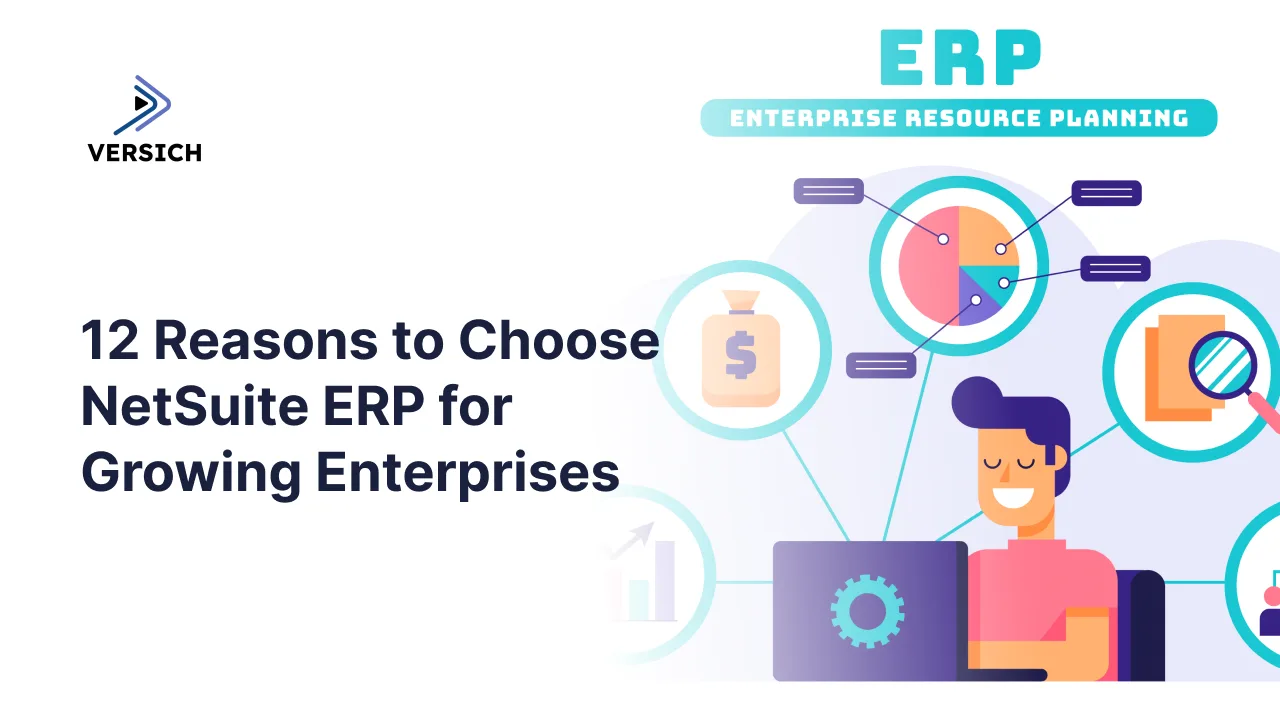
For many growing organizations, NetSuite ERP naturally enters the conversation. As an integrated, cloud-based business management platform, it unifies core functions including accounting, financial management, inventory, procurement, supply chain, CRM, and ecommerce into a single environment. Oracle positions NetSuite as an AI-powered platform designed to automate key workflows while delivering real-time financial and operational visibility. Still, it is not automatically the right fit for every company; choosing an ERP requires carefully evaluating industry-specific needs, transaction volume, existing business processes, reporting demands, required integrations, implementation resources, and total cost of ownership. Even so, organizations actively outgrowing fragmented, disconnected systems often find several of NetSuite's core capabilities particularly compelling.
Here are 12 reasons growing enterprises choose NetSuite ERP.
1. One Connected Platform Instead of Disconnected Systems
One of the biggest challenges in a growing company is application fragmentation. Finance may use an accounting platform while sales operates from a CRM, ecommerce orders may live in another system, warehouse teams may use spreadsheets, and managers may maintain separate reporting files. While each application functions well individually, information must constantly move between them, leading to duplicate customer records, inconsistent item data, manual reconciliations, delayed reports, and fragile integration dependencies.
NetSuite addresses this by providing applications built on a single, shared business database an integrated suite covering accounting, orders, inventory, projects, production, supply chain, and warehouse operations. For a growing enterprise, this establishes a fully connected process. When a customer order is created, rather than requiring manual transfers across disparate tools, the transaction immediately updates inventory availability, fulfillment, invoicing, accounts receivable, customer history, and financial reporting within the same ERP environment. This creates a true single source of truth, delivering far more than mere convenience by dramatically cutting the time employees spend verifying which system holds the accurate data.
2. NetSuite Can Scale as the Business Grows
An ERP system should not solve only today’s problems; it must support the organization as transaction volumes, employees, products, locations, and business entities expand. Scalability is one of the primary drivers behind businesses transitioning from basic accounting tools or legacy ERP platforms to modern cloud solutions. NetSuite’s SaaS architecture enables organizations to seamlessly scale users and capabilities without the burden of building additional in-house infrastructure. As Oracle highlights, companies can activate new modules and functionalities as requirements evolve rather than replacing the entire system. For instance, a growing business might start with core financial management, CRM, and inventory, and two years later seamlessly add manufacturing, advanced procurement, planning and budgeting, warehouse management, and ecommerce, all while expanding within the same platform.
Scalability is especially important for enterprises planning:
acquisitions;
additional warehouses;
ecommerce expansion;
international operations;
new product lines;
additional legal entities; or
rapid increases in transaction volume.
ERP replacement is expensive and disruptive. Choosing a platform with room for expansion can reduce the need for another major system migration after only a few years.
3. Real-Time Financial and Operational Visibility
Growing companies frequently struggle with delayed information; while a report may show what happened last month, leadership needs to understand what is happening now. When departments rely on separate systems, reporting often demands manual data exports, spreadsheet manipulation, reconciliation, and lengthy approvals before management ever sees the final figures by which time circumstances may have already changed. NetSuite’s shared data environment solves this by allowing transactions to update operational and financial records in real time as business activity occurs. As Oracle notes, real-time visibility and reporting are core ERP benefits that empower managers to make agile, informed decisions without waiting on delayed reporting cycles.
Managers can build dashboards around metrics such as:
revenue;
cash flow;
receivables;
payables;
inventory;
sales pipeline;
orders;
procurement;
project profitability;
manufacturing performance; and
subsidiary results.
For example, a CFO reviewing cash flow does not need to rely only on yesterday’s spreadsheet.
A purchasing manager can consider current inventory and incoming purchase orders before placing additional orders. A sales manager can review current pipeline and customer activity. The real value comes from connecting operational activity with financial outcomes.
4. Strong Financial Management Capabilities
For most enterprises, ERP selection ultimately comes back to finance, driven by the critical need for dependable accounting, financial controls, cash visibility, tax processing, revenue management, and streamlined period-end closes. NetSuite addresses this through comprehensive financial management capabilities covering everything from the general ledger, accounts payable, and accounts receivable to cash flow and consolidated reporting. According to Oracle, the platform provides end-to-end visibility ranging from high-level consolidated performance down to individual transactional details. This level of control is especially vital for growing companies, where accounting complexity consistently outpaces headcount growth.
The finance team may need to manage:
more entities;
more transactions;
multiple currencies;
new revenue streams;
larger supplier networks;
intercompany activity;
complex approvals; and
increasingly detailed management reporting.
Without a scalable finance platform, teams compensate through spreadsheets and manual reconciliations. NetSuite can help move many of these processes into controlled workflows.
5. Automation Reduces Repetitive Manual Work
Business growth does not have to require adding headcount at the same pace as transaction volume. A core objective of an ERP system is enabling existing teams to scale efficiently by automating routine administrative tasks and freeing employees to focus on higher-value work. Using NetSuite’s native workflows, SuiteFlow, SuiteScript, scheduled processes, system integrations, and emerging AI tools, organizations can streamline critical operations across the board. This includes automatically routing purchase and sales approvals based on thresholds, sending automated customer and invoice alerts, managing recurring billing, triggering inventory replenishment, and syncing data seamlessly with external applications. Crucially, effective automation does not eliminate human oversight; rather, it eliminates repetitive manual steps while preserving human decision-making for vital financial, operational, and customer-facing exceptions.
6. Better Inventory and Supply Chain Visibility
Inventory management grows increasingly complex as organizations expand across multiple warehouses, ecommerce channels, retail storefronts, suppliers, and product lines. Striking the right balance is critical, as excess stock ties up valuable cash flow while inventory shortages lead to missed sales and dissatisfied customers. This balancing act is further complicated when critical data is fragmented across disparate ecommerce platforms, warehouse tools, spreadsheets, and accounting software. NetSuite ERP directly addresses these challenges by unifying inventory, order management, procurement, supply chain, and warehouse operations to seamlessly connect demand, purchasing, stock, and fulfillment. Consequently, Oracle highlights end-to-end inventory visibility, supply chain optimization, streamlined order management, and warehouse efficiency among the platform's core operational benefits.
A connected inventory environment can help businesses understand:
inventory on hand;
committed inventory;
incoming supply;
reorder requirements;
warehouse availability;
lot or serial information;
fulfilment status;
purchasing activity; and
inventory valuation.
For growing retailers, distributors, ecommerce companies, and manufacturers, this visibility can directly affect working capital and customer experience.
7. Multi-Entity and Global Business Management
Managing a single company is challenging enough, but overseeing several subsidiaries across different countries introduces an entirely new level of complexity. Finance teams frequently face the burden of juggling multiple currencies, distinct taxation requirements, varying accounting rules, intercompany transactions, consolidations, and regional reporting obligations.
NetSuite OneWorld is built to handle these challenges by supporting multiple subsidiaries, business units, currencies, tax jurisdictions, and geographic operations all while delivering unified, consolidated financial visibility. This capability proves especially valuable for organizations expanding through:
International growth;
Mergers and acquisitions;
New legal entities;
Regional subsidiaries;
Franchise structures; or
Separate business units.
Instead of running separate, disconnected ERP instances for each entity and manually piecing together financial results after the fact, organizations can establish a shared multi-entity architecture.
Achieving this efficiency requires deliberate planning during setup. Key elements such as subsidiary hierarchies, currency handling, tax regimes, intercompany elimination workflows, user roles, reporting structures, and local compliance mandates must be properly defined during implementation. Ultimately, the primary benefit lies in deploying a single, scalable architecture capable of handling operational complexity, eliminating the need to repeatedly roll out standalone accounting systems.
8. Cloud ERP Reduces Infrastructure Burden
Traditional on-premises ERP systems require businesses to manage hardware, databases, operating systems, backups, patches, upgrades, and infrastructure capacity. As the organization grows, so does the technical environment. Cloud ERP fundamentally shifts that responsibility. Operating through a Software-as-a-Service (SaaS) model like NetSuite, Oracle manages the underlying infrastructure, maintenance, patches, and platform upgrades while customers access the application via the internet. For a growing enterprise, this significantly reduces the internal IT effort needed simply to keep the platform running.
Teams can instead focus more attention on:
business-process improvement;
system integrations;
data governance;
analytics;
security;
employee support; and
automation.
Cloud ERP also lowers the infrastructure costs typical of traditional ERP deployments by cutting hardware and maintenance overhead in favor of predictable, subscription-based pricing. While this does not eliminate technical administration, organizations must still manage users, permissions, integrations, customizations, testing, data, and twice-yearly release readiness it ensures they no longer have to operate the underlying infrastructure themselves.
9. Access from Anywhere Supports Distributed Teams
Modern businesses rarely operate entirely from one office. Finance employees may work remotely, salespeople travel, warehouse teams operate across multiple locations, and executives need system access while away from headquarters. Cloud ERP provides authorized users access via any standard web browser and internet connection rather than tying them to a physical company network or specific workstation.
NetSuite is browser-based and accessible across computers and supported mobile environments. As Oracle notes, cloud ERP enables employees to access dashboards, reports, approvals, and critical data remotely.
This helps organizations support:
Distributed finance teams;
Multiple warehouses;
International offices;
Remote employees;
Travelling executives;
Field-service teams; and
Hybrid working models.
Crucially, all remote employees work from the same centralized, single source of truth—meaning a regional finance manager never has to reconcile one version of a spreadsheet while headquarters relies on another.
10. Reporting, Analytics, and AI Can Improve Decision-Making
Collecting data is not the same as understanding it, and growing organizations need clear reporting that explains what is happening across both finance and operations. NetSuite delivers this through multiple layers of analytical functionality such as dashboards, KPIs, Saved Searches, SuiteAnalytics Workbook, financial reports, NetSuite Planning and Budgeting, and NetSuite Analytics Warehouse. Because these applications share a unified data foundation, operational and financial metrics can be analyzed together seamlessly. Furthermore, NetSuite is increasingly embedding AI across the platform to simplify routine tasks, recommend actionable next steps, and uncover critical business insights.
Potential use cases include:
Finance: Understanding unusual account movements or reconciliation exceptions.
Sales: Identifying customer or product trends.
Procurement: Analyzing spend and supplier information.
Inventory: Understanding stock movement and demand.
Executives: Summarizing performance across multiple areas of the business.
Ultimately, the quality of these insights depends on the quality of the underlying data. An ERP system cannot compensate for inconsistent customer records, incorrect item structures, poor accounting setup, or undefined KPIs. However, when robust data governance is in place, a shared ERP foundation provides organizations with a powerful platform for advanced analytics and AI.
11. NetSuite Can Support Industry-Specific Processes
ERP systems should not force every business to operate the same way, as a software company has fundamentally different requirements from a manufacturer, just as a distributor faces distinct challenges compared to a professional services organization. To accommodate these differences, NetSuite supports a broad range of modules and configurations that can be combined according to each organization’s specific operating model. Oracle currently offers capabilities across finance, inventory, procurement, supply chain, manufacturing, projects, CRM, ecommerce, human resources, and other key business areas.
A manufacturer may focus on bills of materials, work orders, inventory, purchasing, quality, and costing.
A software company may prioritize subscription billing, revenue recognition, CRM, renewal management, and planning.
A professional services company may require projects, resource management, timesheets, expenses, billing, and profitability analysis.
A wholesale distributor may emphasize inventory, purchasing, warehouse operations, order management, pricing, and ecommerce.
A multi-entity enterprise may prioritize consolidation, intercompany transactions, currencies, tax, and global reporting.
The core advantage is that a business can build around a common ERP foundation while introducing capabilities tailored specifically to its industry.
12. NetSuite Can Create a Long-Term Platform for Growth
Perhaps the most important reason enterprises choose NetSuite is not one specific module, but the ability to build a broader business platform. A growing company may initially implement NetSuite because entry-level accounting software can no longer manage its financial complexity. Once the ERP foundation is established, the organization can scale across several operational areas:
Inventory management
Planning and analytics
Ecommerce and CRM
Projects and manufacturing
Integrations and process automation
NetSuite’s modular cloud architecture allows companies to introduce these additional capabilities as requirements evolve, avoiding the costly cycle of repeatedly replacing core systems at each new stage of growth.
However, realizing this long-term value depends heavily on system architecture. If an environment becomes overloaded with unnecessary scripts, duplicate fields, conflicting workflows, and poorly designed integrations, scalability suffers. Implementation strategy and ongoing governance matter just as much as product selection, meaning NetSuite must be managed as a scalable business foundation rather than a disconnected collection of individual features.
NetSuite ERP Benefits at a Glance
Business Need | How NetSuite Can Help |
Disconnected applications | Brings core financial and operational processes into an integrated environment |
Growing transaction volume | Provides a scalable cloud architecture |
Delayed reporting | Offers dashboards, KPIs, and real-time operational data |
Financial complexity | Supports accounting, financial management and consolidation |
Repetitive manual work | Enables workflow and process automation |
Inventory challenges | Connects purchasing, inventory, orders and fulfilment |
International growth | Supports subsidiaries, currencies and consolidated reporting |
High IT infrastructure burden | Operates as a vendor-managed cloud SaaS platform |
Distributed workforce | Provides browser-based access to authorized users |
Limited analytics | Supports SuiteAnalytics, planning, data warehousing and AI capabilities |
Industry complexity | Offers modules for manufacturing, services, commerce and other processes |
Future expansion | Allows additional capabilities to be introduced over time |
When Should a Growing Enterprise Consider NetSuite?
Growth alone does not mean a business needs NetSuite immediately; the stronger signal is operational complexity. You may want to evaluate NetSuite when employees spend increasing amounts of time reconciling disconnected systems rather than working with customers or analyzing performance. Other key signs include financial reporting that relies heavily on manual spreadsheets, inventory counts that conflict across channels, friction managing multiple subsidiaries, error-prone manual billing, brittle integrations, or legacy ERP software demanding costly infrastructure maintenance.
Another common trigger arises when leadership cannot quickly answer fundamental operational questions, such as:
How much inventory is actually available?
Which customers are overdue?
What is the profitability of this product line?
Which subsidiary is underperforming?
How much cash will we need next quarter?
Which orders are waiting for fulfillment?
When answering these questions requires a coordinated effort across multiple teams and spreadsheets, the organization’s foundational systems are no longer keeping pace with its growth.
NetSuite vs. Maintaining Multiple Business Applications
When managing business growth, many organizations fall into the trap of adopting standalone software whenever a department faces a challenge: sales brings in a CRM, finance adds an expense tool, operations deploys inventory software, the warehouse adopts its own system, and leadership turns to a separate BI platform. While this piecemeal approach works temporarily, it inevitably forces companies to spend excessive time and effort integrating and reconciling disconnected data. Transitioning to NetSuite does not necessarily mean eliminating every specialized tool; many businesses continue leveraging external platforms for CRM, ecommerce, logistics, payroll, and banking. The critical difference is that NetSuite serves as the central ERP core that governs how these systems interact, transforming a messy collection of independent applications into a unified, deliberate architecture.
NetSuite Cloud ERP vs. Legacy On-Premises ERP
Businesses already using an ERP often ask why they should consider replacing it, especially when the core issue is rarely missing functionality. Instead, the challenge lies in the cost and complexity of keeping the system current. On-premises ERP environments require organizations to maintain servers, operating systems, databases, patches, backups, upgrades, and infrastructure capacity, an effort further complicated by customizations that make updates increasingly difficult. Oracle notes this often leads to "version lock," where companies repeatedly postpone upgrades due to excessive disruption and testing requirements. In contrast, Cloud SaaS ERP shifts infrastructure and platform maintenance to the vendor, enabling frequent, seamless upgrades that provide growing enterprises with greater flexibility to adopt new processes and technologies.
What Should You Consider Before Choosing NetSuite?
NetSuite offers significant capabilities, but implementing ERP successfully requires preparation. Before making the final decision, assess several areas.
Business Processes
Identify which processes are currently inefficient and how they should work after implementation. Avoid simply reproducing every legacy workflow in NetSuite.
Data
Review customers, suppliers, products, accounts, inventory, projects, and historical transactions before migration. Poor source data will become poor ERP data.
Integrations
Determine which systems will remain outside NetSuite and define how customers, products, orders, payments, inventory, and other records will synchronize.
Reporting
Define the financial and operational KPIs leadership actually needs. Do not wait until immediately before go-live to design critical reports.
Users
Employees need role-based training around real business processes, not only generic NetSuite demonstrations.
Customization
Evaluate standard NetSuite configuration before introducing custom SuiteScript. Customization should solve a genuine requirement, not replicate unnecessary behaviour from a legacy system.
Implementation Partner
The quality of the implementation can significantly affect the value organizations receive from NetSuite. A partner should understand both NetSuite and your accounting, operational, integration, data, and reporting requirements.
How Versich Helps Growing Enterprises Implement NetSuite
Choosing NetSuite is only the beginning. The business value comes from how the platform is designed, configured, integrated, adopted, and improved after implementation. We help organizations build NetSuite environments around their actual finance and operational requirements.
Our NetSuite services include:
We follow a business-focused and finance-first approach. We assess how sales, finance, procurement, inventory, projects, ecommerce, reporting, and technology should work together before configuring the system. The goal is not simply to get NetSuite live. The goal is to create an ERP foundation that continues supporting the organization as its processes, transaction volumes, and reporting requirements evolve.
Choose an ERP That Can Support the Next Stage of Growth
A growing enterprise quickly outgrows basic accounting software, requiring a scalable technology foundation built on deep visibility, internal controls, automation, and reliable data to handle increasing operational complexity. NetSuite provides this framework by unifying financial and operational processes within a single cloud platform, delivering value through centralized data, real-time analytics, inventory management, global capabilities, and modular expansion. However, the platform delivers its strongest return on investment only when supported by well-designed processes, clean data, controlled customization, robust integration architecture, and high user adoption. Ultimately, selecting the right ERP is only the first step; how it is implemented, customized, and managed is equally critical to sustaining long-term growth.