Introduction
For subscription-based and service-driven businesses, contract renewals are the engine that sustains recurring revenue. Yet for many companies, the process is fragmented, manual, and reactive. Sales reps track expiry dates in spreadsheets, finance chases renewal invoices weeks late, and revenue recognition adjustments eat up hours that could be spent on growth. The result is missed renewals, strained customer relationships, and revenue leakage that quietly erodes the bottom line.
NetSuite Contract Renewals changes this entirely. As part of Oracle NetSuite's broader cloud ERP suite, the Contract Renewals module gives businesses a unified, automated platform to manage the full contract lifecycle, from initial quote through recurring billing, revenue recognition, renewal execution, and performance monitoring. Whether you are managing dozens of contracts or thousands, NetSuite provides the structure, automation, and visibility to ensure no renewal is ever missed.
This guide covers everything you need to know: what NetSuite Contract Renewals is, its key capabilities and benefits, how it integrates with the broader NetSuite ecosystem, common pain points it eliminates, licensing considerations, and why partnering with an experienced NetSuite consultancy like Versich puts you on the fastest path to a successful deployment.
What is NetSuite Contract Renewals?
NetSuite Contract Renewals is a native module within the Oracle NetSuite ERP platform designed to automate and centralise the end-to-end management of recurring contracts. It is built for organisations that sell subscription services, support agreements, maintenance contracts, or any recurring revenue arrangement where contracts must be tracked, renewed, and billed consistently over time.
At its core, the module enables businesses to create and maintain contract records that capture every relevant dimension of an agreement: the customer, the contracted services or items, start and end dates, renewal terms, billing schedules, pricing uplifts, and the associated revenue recognition rules. These contract records serve as the single source of truth, eliminating the need for disconnected spreadsheets, calendar reminders, or manual billing runs.
NetSuite Contract Renewals is tightly integrated with other NetSuite modules, including Order Management, Billing, Advanced Revenue Management (ARM), and CRM. This means that a contract renewal does not just trigger a new invoice; it flows through the entire financial and operational ecosystem: generating Sales Orders, updating revenue schedules, notifying responsible stakeholders, and providing management with real-time visibility into renewal performance.
The module is particularly powerful for businesses experiencing growth, where the complexity of managing a growing contract portfolio quickly outpaces manual methods. With NetSuite, renewals can be automated to execute without manual intervention or flagged for review and approval based on configurable business rules.
The NetSuite Contract Renewal Lifecycle
The diagram below illustrates how NetSuite orchestrates every stage of the contract and renewal lifecycle, from initial quote through to driving renewal, all through a single connected platform.
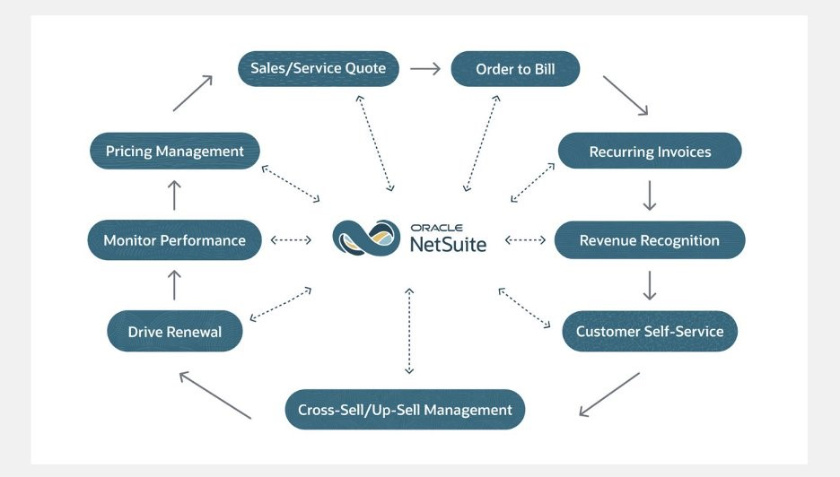
Oracle NetSuite Contract & Renewal Lifecycle
Each node in this lifecycle is managed natively within NetSuite. The Sales or Service Quote kicks off the contract. Order to Bill converts that quote into a binding commitment with associated billing schedules. Recurring Invoices are generated automatically against the contract. Revenue Recognition applies the appropriate accounting treatment. Customer Self-Service provides transparency to clients. Cross-Sell and Up-Sell Management surfaces expansion opportunities. Monitor Performance tracks contract health and KPIs. Pricing Management ensures renewal terms reflect current pricing rules. And Drive Renewal closes the loop, triggering automated or managed renewal workflows.
Key Benefits of NetSuite Contract Renewals
NetSuite Contract Renewals delivers tangible operational, financial, and strategic benefits. Below are the core capabilities and the value they unlock.
Official NetSuite Contract Renewals Data Sheet:https://www.netsuite.com/portal/collateral/public/ds-contract-renewals.pdf
1. Renewal Automation
Manual renewal management is inherently error-prone. When contracts are tracked in spreadsheets or calendar reminders, the risk of a renewal slipping through the cracks is real, and the cost of a missed renewal in lost ARR is high. NetSuite eliminates this risk through workflow-driven renewal automation.
Using SuiteFlow, NetSuite's built-in workflow engine, businesses can configure automated triggers based on contract end dates. For example, a workflow can be set to fire 90, 60, and 30 days before contract expiration, automatically sending renewal notifications to the account owner, the customer success manager, and the customer. For evergreen or auto-renew contracts, the renewal can be executed entirely without human intervention, generating a new Sales Order and billing schedule the moment the previous term closes.
The result is a zero-touch renewal process for routine contracts, with human escalation reserved for at-risk accounts, pricing negotiations, or contracts requiring scope changes. Businesses typically report a significant reduction in administrative overhead and a measurable improvement in renewal rates once automation is in place.
Automated renewal notifications at configurable lead times (90/60/30 days)
Auto-generation of renewal Sales Orders and billing schedules
Configurable auto-renew vs. manual renewal rules per contract type
Escalation workflows for at-risk or high-value renewals
Audit trail of all renewal actions for compliance and reporting
2. Multi-Contract Management
Enterprise customers often hold multiple contracts with a business simultaneously, covering different product lines, service tiers, geographic entities, or subsidiaries. Managing these contracts in isolation creates inconsistency and administrative burden. NetSuite provides a unified multi-contract management environment where all contracts for a given customer, or across your entire portfolio, are visible and manageable from a single platform.
Contract records in NetSuite can be associated with specific customers, subsidiaries, currencies, and billing frequencies. For organisations running multi-subsidiary or multi-currency operations under NetSuite OneWorld, contract data rolls up correctly across entities, ensuring consolidated renewal visibility without manual reconciliation. Finance teams can see total contracted ARR by entity, currency, product line, or customer segment in real time.
Portfolio-level management also supports co-termination strategies, where multiple contracts for the same customer are aligned to a common renewal date, simplifying the commercial relationship and reducing the number of renewal touchpoints.
Centralised contract repository across all customers and subsidiaries
Multi-currency and multi-subsidiary support via NetSuite OneWorld
Co-termination support to align renewal dates across a customer portfolio
Bulk renewal processing for high-volume contract portfolios
Contract hierarchies linking parent and child agreements
3. Uplift and Discount Management
Pricing stagnation at renewal is a common source of margin erosion. Without a structured process to apply annual price increases or CPI adjustments, many businesses inadvertently lock themselves into below-market pricing across large portions of their contract base. NetSuite's Uplift and Discount Management capabilities address this directly.
Businesses can configure uplift rules at the contract, customer, or item level. Uplifts can be defined as a fixed percentage, a CPI-linked adjustment, or a custom formula. When a renewal is triggered, NetSuite automatically applies the appropriate uplift to the renewal pricing, with options for customer-specific overrides or management approval workflows for discount exceptions. This ensures pricing discipline at scale without requiring manual review of every contract at renewal.
Discount management works in tandem, providing visibility into discounts applied at renewal and flagging renewals where the effective price has moved below defined thresholds. Combined, these capabilities protect margin and provide commercial teams with the data they need to manage pricing strategy across the contract portfolio.
Configurable price uplift rules by contract, customer, or item category
CPI-linked, percentage-based, or custom formula uplifts
Approval workflows for discounts exceeding defined thresholds
Pricing history and audit trail across renewal cycles
Reporting on effective price movements and margin impact at renewal
4. Revenue Recognition
Revenue recognition on contracts is one of the most technically demanding areas of financial compliance, particularly under ASC 606 and IFRS 15. Misapplying rev rec rules at renewal, especially when contract terms change, can create material errors in financial statements. NetSuite's Advanced Revenue Management (ARM) module works natively with Contract Renewals to ensure compliant, automated revenue recognition across all renewal scenarios.
When a contract is renewed, ARM automatically creates or updates the revenue schedule for the new term. If the renewal involves a price change, scope change, or modification, ARM handles the modification accounting, including catch-up adjustments and reallocation of Standalone Selling Prices (SSP) where applicable. This eliminates the need for manual journal entries at renewal and ensures that revenue is recognised in the correct periods without spreadsheet-based workarounds.
For businesses with complex multi-element arrangements, such as software licences bundled with support and professional services, ARM provides allocation and recognition at the performance obligation level, maintaining compliance throughout the renewal lifecycle.
Automated revenue schedule creation and update at renewal
ASC 606 and IFRS 15 compliant recognition throughout the contract term
Modification accounting for scope and price changes at renewal
SSP reallocation for multi-element performance obligations
Elimination of manual rev rec journal entries at renewal
5. Reporting and Visibility
Leadership teams need real-time visibility into renewal performance to make informed decisions about resource allocation, revenue forecasting, and customer retention strategy. NetSuite provides a comprehensive suite of reporting tools that put renewal intelligence directly in the hands of the people who need it.
Using NetSuite's SuiteAnalytics platform, businesses can build renewal dashboards that surface key metrics including upcoming renewals by month, renewal rate by customer segment, ARR at risk, average contract value at renewal, and uplift realised versus planned. These dashboards can be role-based, ensuring that sales leaders, finance teams, and executives each see the metrics most relevant to their function.
Saved searches provide granular contract-level data for operational teams, enabling them to filter and action contracts based on renewal date, owner, risk status, or contract value. Combined with NetSuite's native email alerting and KPI portlets, the platform ensures that renewal activity is never invisible to the business.
Real-time renewal dashboards with ARR at risk, renewal rate, and pipeline metrics
Role-based KPI portlets for sales, finance, and executive stakeholders
Saved searches for contract-level operational management
Renewal forecasting integrated with NetSuite financial planning
Audit-ready reporting on renewal history, pricing changes, and approvals
Issues Companies Face Without a Contract Management Solution
Before adopting NetSuite Contract Renewals, many organisations relied on a combination of spreadsheets, CRM notes, email reminders, and manual billing runs to manage their contract portfolio. This approach introduces significant operational and financial risk as the business scales. The consequences are often severe and difficult to quantify until they manifest as revenue loss or customer churn.
Missed Renewals and Revenue Leakage
Without automated tracking, contracts routinely expire without a renewal conversation being initiated. In high-volume environments, even a small percentage of missed renewals represents a material loss of ARR. Research across SaaS and services businesses consistently finds that lapsed contracts are far harder to re-win than renewals managed proactively, with recovery rates often below 30 percent of the original contract value.
Manual Billing Errors
When renewal invoices are generated manually, errors in pricing, term dates, and billing frequencies are common. These errors erode customer trust, trigger disputes, and create additional administrative burden to resolve. For businesses with CPI uplift clauses or tiered pricing, the complexity of getting renewal billing right without automation is substantial.
Revenue Recognition Risk
Manual rev rec processes at renewal are a known source of audit findings and restatement risk. Without automated modification accounting, finance teams frequently misapply ASC 606 rules when contracts are amended at renewal, particularly for multi-element arrangements. The cost of a restatement, in management time, audit fees, and reputational damage, far exceeds the cost of a compliant automated solution.
Lack of Portfolio Visibility
Without a centralised contract repository, leadership teams have no reliable view of upcoming renewals, ARR at risk, or renewal performance trends. Decisions about sales headcount, customer success investment, and revenue forecasting are made on incomplete or stale data, leading to resource misallocation and missed growth opportunities.
Inconsistent Pricing Discipline
Without structured uplift management, account managers often renew contracts at the previous year's pricing to minimise friction with the customer. Over time, this creates significant pricing inconsistency across the portfolio and leaves material margin on the table. Businesses operating in inflationary environments are particularly exposed.
Compliance and Audit Exposure
The absence of an auditable contract record, with a complete history of amendments, approvals, pricing changes, and renewal actions, creates significant compliance exposure. Auditors increasingly expect businesses to demonstrate end-to-end contract governance, and gaps in the audit trail can trigger findings that require costly remediation.
Pricing and Cost of NetSuite Contract Management
NetSuite operates on a subscription licensing model, and the total cost of a NetSuite implementation depends on several variables including the base platform edition, the number of users, the specific modules licensed, and the level of implementation support required. Contract Renewals is a module that is typically licensed as an add-on to the core NetSuite platform.
Note: Oracle NetSuite does not publish fixed pricing publicly. Costs are negotiated based on your organisation's size, industry, user count, and module requirements. The information below reflects general market guidance.
As a general framework for budgeting purposes:
Base NetSuite Platform: Annual licensing typically starts in the range of $10,000 to $30,000+ per year for the core platform, scaling with user count and edition.
Contract Renewals Module: Licensed as an add-on, this module is typically priced in the range of $2,000 to $10,000+ per year depending on volume and negotiation.
Advanced Revenue Management (ARM): If required for ASC 606 compliance, ARM is a separate module with additional licensing cost.
NetSuite OneWorld: Required for multi-subsidiary deployments, OneWorld carries an additional per-entity licensing fee.
Implementation Services: Implementation by a certified NetSuite partner typically ranges from $25,000 to $150,000+ depending on complexity, customisation, and integration requirements.
The most important consideration when evaluating cost is ROI. For a business with $5 million in ARR at renewal risk, a 5 percent improvement in renewal rate through automation represents $250,000 in protected revenue annually. The licensing cost of the Contract Renewals module is typically recovered within the first renewal cycle for any organisation with meaningful recurring revenue.
To obtain an accurate quote tailored to your business requirements, contact Versich or reach out to Oracle NetSuite directly. Versich's team can help you scope the right modules, negotiate licensing terms, and size the implementation engagement to ensure you achieve the fastest possible return on investment.
NetSuite Modules That Work Together with Contract Management
One of the defining strengths of NetSuite Contract Renewals is its native integration with the broader NetSuite ecosystem. Unlike standalone contract management tools that require API integrations and custom data mapping, NetSuite's modules share a common data model, ensuring that contract data flows accurately and automatically across the business.
Order Management
When a renewal is executed, NetSuite automatically generates a Sales Order linked to the renewed contract. This Sales Order inherits all relevant pricing, billing schedule, and fulfilment settings from the contract record, eliminating manual re-entry and ensuring consistency between the commercial agreement and the operational record.
Billing and Recurring Invoicing
The Billing module manages the automatic generation of invoices against active contracts and renewal schedules. Businesses can configure billing frequencies (monthly, quarterly, annual), invoice templates, and payment terms at the contract level. Recurring billing runs execute automatically, ensuring that renewal invoices are generated on schedule without manual intervention.
Advanced Revenue Management (ARM)
ARM is the compliance backbone of NetSuite's contract management capability. It manages revenue schedule creation, modification accounting, SSP allocation, and period-by-period recognition entries. For businesses subject to ASC 606 or IFRS 15, ARM is an essential companion to the Contract Renewals module.
CRM and Customer Management
NetSuite's native CRM connects contract records to customer activity, support history, and opportunity pipeline. When a renewal is approaching, account managers can see the full customer relationship context, including open support tickets, previous renewal history, and upsell opportunities, directly within the renewal workflow.
SuiteAnalytics and Reporting
SuiteAnalytics provides the reporting and visualisation layer for contract data. Renewal dashboards, ARR reports, and cohort analyses are built natively within NetSuite, using the same underlying data that drives billing and recognition. This eliminates the data export and reconciliation steps required by external BI tools.
SuiteFlow
SuiteFlow is the automation backbone for renewal workflows. It enables businesses to configure multi-step approval processes, automated notifications, escalation rules, and conditional renewal logic without writing code. For more complex requirements, SuiteScript extends SuiteFlow with custom business logic.
Procurement and Vendor Management
For businesses that resell third-party services or manage vendor contracts alongside customer agreements, NetSuite's Procurement module provides visibility into vendor renewal obligations, ensuring that upstream vendor terms are aligned with downstream customer commitments.
iPaaS Integrations (Boomi, Celigo, MuleSoft, Workato, Jitterbit)
Where NetSuite needs to share contract data with external systems, such as a Salesforce CRM, a CPQ tool, a customer portal, or a data warehouse, iPaaS platforms including Boomi, Celigo, MuleSoft, Workato, and Jitterbit, provide robust, pre-built connectors. Versich has deep expertise across all major iPaaS platforms and can architect and build the integration layer that connects NetSuite's contract data to your broader technology ecosystem.
Why Versich is the Right Choice for NetSuite Contract Management
Implementing NetSuite Contract Renewals is not simply a software deployment exercise. It requires a deep understanding of your commercial model, your revenue recognition requirements, your billing processes, and the specific ways your business manages customer relationships. Getting it wrong means building on an unstable foundation that becomes harder and more expensive to fix as the business grows. Getting it right means a platform that drives revenue, protects margin, and gives leadership the visibility they need to make confident decisions.
Versich is a specialist NetSuite consulting and managed services firm. We have delivered NetSuite implementations, customisations, and integrations across a wide range of industries, with particular depth in subscription and services businesses where contract management is mission-critical.
Our Capabilities
Module Setup: NetSuite Contract Renewals Implementation
We configure the Contract Renewals module to match your specific commercial model, including renewal types, billing schedules, uplift rules, and approval workflows. We do not apply generic templates; every implementation is designed around your business.
Rev Rec Compliance: Advanced Revenue Management (ARM) Configuration
Our team has hands-on experience configuring ARM for ASC 606 and IFRS 15 compliance, including multi-element arrangements, contract modifications, and SSP allocation. We ensure your revenue recognition is accurate and audit-ready from day one.
Custom Automation: SuiteScript and SuiteFlow Development
Where native NetSuite functionality needs to be extended, our SuiteScript developers build custom User Event Scripts, Client Scripts, Scheduled Scripts, and Suitelets that handle complex renewal logic, bulk processing, and bespoke workflow requirements.
Cross-System Connectivity: iPaaS Integration Services
We design and build integrations between NetSuite and your wider technology stack using Boomi, Celigo, MuleSoft, Workato, and Jitterbit. Whether you need to sync contract data with Salesforce, push renewal invoices to a customer portal, or feed renewal metrics into a BI platform, we handle the full integration lifecycle.
Post Go-Live: Managed Services and Ongoing Support
Our managed services offering provides ongoing NetSuite administration, SuiteScript development, and integration support. As your contract portfolio grows and your business evolves, Versich is the partner that keeps your NetSuite environment performing at its best.
Versich has helped businesses across the US and UK replace fragmented contract management processes with structured, automated NetSuite environments that protect revenue, reduce administrative overhead, and deliver the financial visibility that leadership teams need. If your business is evaluating NetSuite Contract Renewals or looking to optimise an existing deployment, we are the partner you want in your corner. Contact Us
Conclusion
Contract renewals are not a back-office administrative task. They are the commercial engine of any recurring revenue business, and the quality of the processes and systems supporting them directly determines how much of that revenue is captured, retained, and grown. Manual, spreadsheet-driven renewal management is a liability that grows more dangerous as the business scales.
NetSuite Contract Renewals provides the automation, integration, and visibility that modern businesses need to manage their contract portfolio with confidence. From automated renewal workflows and uplift management to ASC 606-compliant revenue recognition and real-time renewal dashboards, the platform eliminates the operational risks associated with manual contract management and replaces them with a structured, scalable process that drives renewal performance.
Versich brings the implementation expertise, SuiteScript development capability, and iPaaS integration experience to deploy NetSuite Contract Renewals in a way that is precisely configured to your business model. We have delivered these implementations for businesses worldwide and we understand the nuances that separate a successful deployment from a frustrating one.
If your business is ready to move beyond spreadsheets and take control of its contract renewal lifecycle, Versich is the partner to make it happen. Contact us today to start the conversation.