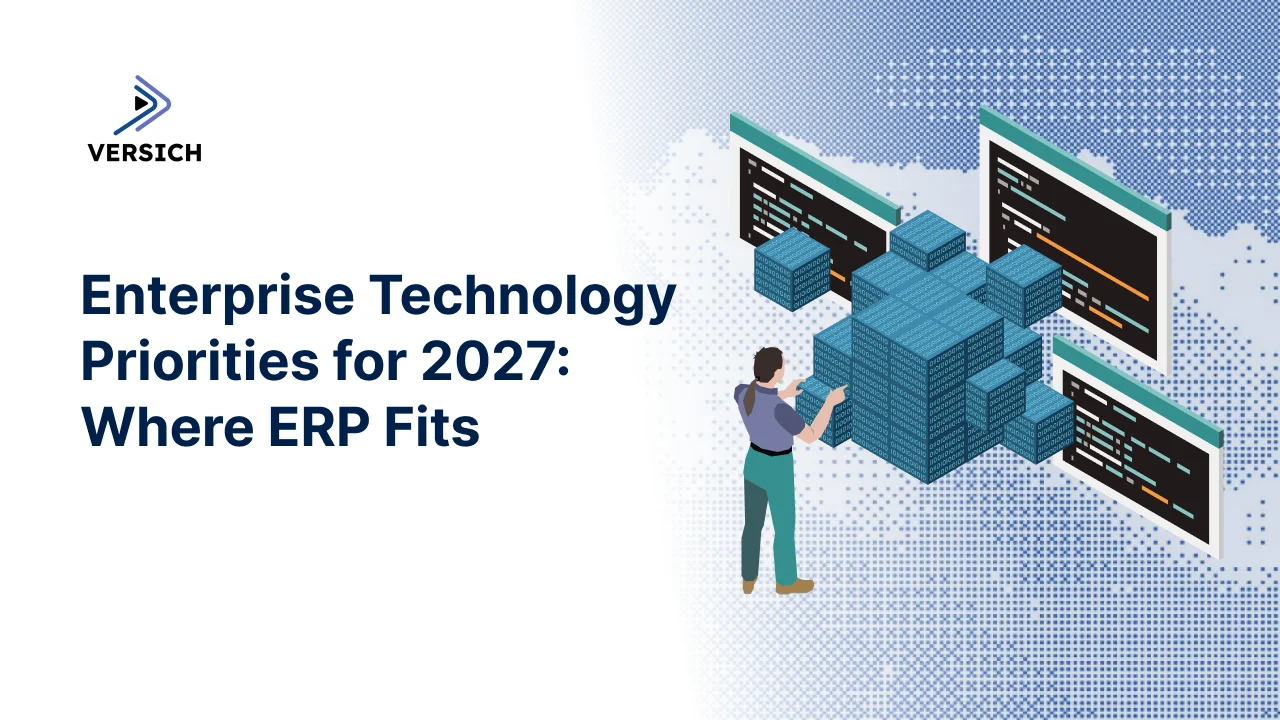
Scan any list of enterprise technology priorities for 2027 and the same names dominate: AI, agentic automation, cloud, data. ERP rarely makes the headline. It feels like settled infrastructure, the thing you already have, not the thing you plan around.
That framing is a mistake, and it is an expensive one. Because almost every priority on the 2027 list, especially AI, depends on something underneath it that most roadmaps take for granted: a modern, connected ERP holding clean, trusted data. As one Deloitte leader put it, AI is not the death of ERP; ERP is what makes the value of AI possible.
This article looks at the enterprise technology priorities shaping 2027 and, more importantly, where ERP actually fits among them, not as legacy plumbing, but as the foundation the rest of the roadmap stands on.
The 2027 Enterprise Technology Priorities
Across analyst commentary and CIO surveys, a handful of priorities keep topping the 2027 agenda:
- Agentic AI and automation , AI shifts from answering questions to taking action: flagging anomalies, drafting schedules, triggering workflows. Gartner projects that by 2030, more than half of foundational ERP tasks could run autonomously.
- Cloud migration , on-premises systems are reaching end of life, and support deadlines (SAP Business Suite 7 ends December 2027) are forcing the move. Cloud is now the architectural standard.
- Data readiness , AI and analytics are only as good as the data beneath them, making clean, governed, accessible data a priority in its own right.
- Modernisation over net-new , the ERP market is in an upgrade "supercycle," with around half of CIOs planning to modernise their core in the next few years.
Every one of these priorities points back to the same place.
Where ERP Fits: The System of Record Beneath Everything
The clearest way to understand ERP's role in 2027 comes from how analysts now describe the enterprise stack: a core of systems of record, your ERP, surrounded by an outer layer of systems of action, the agentic, AI-enabled processes that wrap around that core.
| System of Record (ERP core) | System of Action (AI layer) |
|---|---|
| Holds the single source of truth | Acts on that data |
| Finance, operations, inventory, transactions | Agents, automation, insights |
| Must be modern, clean, and connected | Only as good as the core beneath it |
| The foundation | The layer on top |
In that model, ERP is not competing with AI or being replaced by it. It is the thing that makes AI useful. The agent drafting a payment run, flagging a ledger anomaly, or forecasting supply needs the ERP's data and transactional context to act on. Strip that away and the AI is an impressive demo with nothing reliable underneath it.
This is why "where does ERP fit in 2027?" has a simple answer: at the centre. Every other priority, AI, automation, analytics, is a layer on top of the ERP core. The organisations that treat ERP as the foundation for AI, rather than a legacy system to work around, are the ones positioned to get value from everything else on the 2027 list.
Why the Core Has to Be Modernised First
There is a catch, and it is the part most 2027 roadmaps underestimate. A legacy, heavily customised, or disconnected ERP cannot support the AI and automation layer sitting on top of it. As Deloitte's enterprise practice puts it, you have to modernise the core before you layer on AI capabilities, and modernising ERP is not a cost, it is the catalyst that unlocks the value you are chasing.
The reasons are practical. AI embedded in the transactional process is where it gains the context to be useful, and that requires a modern, connected core. Decades of custom code and siloed data block that value rather than enable it. So the AI initiative that looks like a 2027 priority is really an ERP-readiness priority wearing a more exciting label.
This also reframes the modernisation "supercycle." The surge in NetSuite implementation and ERP modernisation projects is not firms chasing a trend. It is firms recognising that the AI roadmap stalls without a modern core to run it on.
What This Means for Your 2027 Roadmap
If ERP is the foundation the rest of 2027 depends on, the planning sequence changes. Instead of budgeting for AI tools and treating the ERP as a given, the stronger approach runs the other way:
Start by assessing whether your current ERP can actually support what you want to build, clean data, connected processes, room for AI to act with context. Prioritise modernising or connecting the core where it is holding you back, especially the finance and operations processes that everything else depends on. Then layer AI and automation onto that foundation, where they have the data and context to deliver real value rather than demo-grade results.
For most mid-market businesses, this is exactly where a platform like NetSuite earns its place, a modern, cloud, connected ERP core that can serve as the system of record while AI-enabled processes wrap around it. Get that core right, and the rest of the 2027 roadmap has something solid to stand on.
Conclusion
The enterprise technology priorities for 2027 are real, AI, automation, cloud, and data will define the year. But the priority beneath all of them is the one that rarely makes the list: a modern, connected ERP core.
ERP in 2027 is not legacy infrastructure to be replaced by AI. It is the system of record that makes AI, automation, and analytics worth deploying. The businesses that modernise and connect that core first will turn the rest of their 2027 roadmap into results. The ones that treat ERP as an afterthought will find their AI ambitions stalling on a foundation that cannot support them.
If you are planning where ERP fits in your 2027 technology roadmap, and how to get the core ready for what you want to build on top of it, that is exactly the kind of question our team helps with.