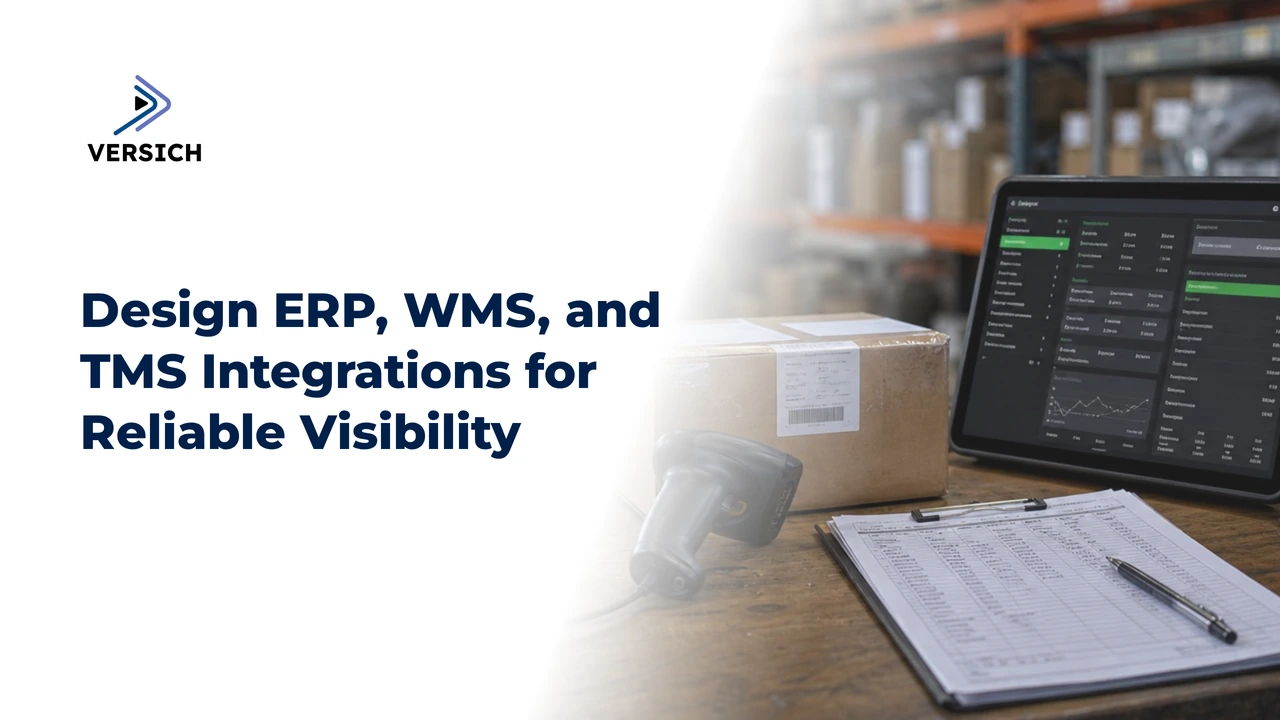
Picture a team trying to answer a simple question: Where is the order, and when will it arrive? The ERP has the financial record, the WMS has warehouse activity, and the TMS has transportation events. If those systems exchange incomplete, late, or duplicated data, the business still lacks a reliable answer. ERP, WMS, and TMS integrations connect financial, inventory, warehouse, and transportation processes through defined data ownership, event timing, validation, and error handling. Reliable visibility comes from more than moving records between applications. It depends on designing the right business events, assigning each data element to a system of record, and making exceptions visible to the people responsible for resolving them.
What Do ERP, WMS, and TMS Integrations Connect?
ERP, WMS, and TMS integrations connect three operational perspectives that must work together but should not all own the same data.
An enterprise resource planning system, or ERP, typically manages orders, purchasing, inventory valuation, customers, suppliers, financial postings, and broader business controls. A warehouse management system, or WMS, manages warehouse execution, including receiving, putaway, picking, packing, replenishment, cycle counting, and shipment confirmation. A transportation management system, or TMS, manages carrier selection, routing, tendering, freight planning, tracking events, delivery appointments, and freight settlement processes.
The integration joins those perspectives without flattening them into one undifferentiated data stream. A sales order may originate in the ERP, but the WMS needs an executable fulfillment request. The WMS may confirm that inventory was picked and packed, while the TMS needs shipment details, package dimensions, and carrier instructions. The TMS then returns events such as tender acceptance, pickup, in-transit status, delivery, or exception.
The important distinction is between business records and operational events. A business record describes something that exists, such as an order, item, shipment, or invoice. An event describes something that happened, such as inventory received, a pick completed, a load tendered, or a delivery delayed.
A practical integration design answers these questions before development begins:
Which system creates each record?
Which system is allowed to update it?
Which fields move between systems?
Is the exchange real-time, scheduled, or event-driven?
What happens when a message fails?
How does the receiving system identify a duplicate?
Which users see and resolve exceptions?
Versich’s NetSuite integration guidance reflects the same architectural concern: integrations need error handling, retry logic, and designs that remain maintainable as connected platforms change. The principle applies whether the ERP is NetSuite, another cloud ERP, or an on-premises platform.
Why Does Visibility Break Across ERP, WMS, and TMS Platforms?
Visibility breaks when systems exchange transactions without exchanging the context needed to interpret them. A shipment confirmation without package identifiers, a tracking event without a shipment reference, or an inventory update without a location can create a technically successful interface and an operationally useless result.
Several design problems appear repeatedly.
Unclear ownership creates conflicting values. If both the ERP and WMS can change available quantity, one system will eventually overwrite the other or display a different result. The integration needs a rule for whether the WMS owns physical warehouse quantity while the ERP owns financial inventory and order allocation.
Status mapping hides important distinctions. “Shipped” might mean a label was created, a package was packed, a carrier accepted the tender, or the shipment physically departed. Those are different events. Compressing them into one status removes information that customer service, warehouse operations, and transportation teams need.
Timing assumptions produce false confidence. A batch synchronization that runs every hour may be acceptable for financial reporting but unsuitable for appointment changes or carrier exceptions. A real-time design also needs boundaries, because not every process requires immediate transmission.
Identifiers do not align automatically. ERP item numbers, WMS license plate numbers, TMS shipment IDs, carrier tracking numbers, purchase order numbers, sales order numbers, and warehouse task IDs all serve different purposes. A cross-reference strategy is essential.
Failures disappear into technical logs. A message can fail because of a missing location, invalid carrier code, closed order, duplicate shipment, or authentication problem. Operational users need an understandable exception queue, not only an application log.
A useful integration does not promise that every system will show identical screens. It ensures that each system presents the right view for its users and that the underlying business events remain traceable.
How Should You Assign System Ownership?
System ownership should follow the process that creates and governs the data, not the application that happens to display it most conveniently.
For example, the ERP may own the commercial order, customer account, payment terms, and financial status. The WMS may own warehouse task status, bin movement, license plate or pallet identity, pick confirmation, and packing completion. The TMS may own the carrier tender, route, appointment, freight charge, and transportation milestone.
The following model gives teams a starting point. Actual ownership depends on configuration, operating procedures, and industry requirements.
| Data or event | Likely system of record | Common consumers | Design detail to define |
|---|---|---|---|
| Sales order and customer terms | ERP | WMS, TMS, customer service | Release rules, holds, credit status, requested dates |
| Inventory by warehouse location | WMS for physical execution, ERP for enterprise inventory and valuation | ERP, order management, reporting | Available, allocated, damaged, held, and in-transit quantities |
| Pick, pack, and ship confirmation | WMS | ERP, TMS, customer service | Partial shipments, package IDs, lot or serial details |
| Shipment planning and carrier tender | TMS | WMS, ERP, transportation team | Carrier, service level, appointment, route, and tender response |
| Tracking milestones | TMS or carrier network | ERP, customer service, portals, analytics | Event code mapping, timestamps, time zones, and late thresholds |
| Purchase receipt | WMS | ERP, accounts payable, procurement | Received quantity, inspection status, lot or serial data |
| Freight invoice and accessorial charges | ERP or TMS, depending on process | Finance, procurement, reporting | Accruals, matching rules, dispute workflow |
| Delivery confirmation | TMS or carrier | ERP, customer service, billing | Proof of delivery, exceptions, signature or delivery timestamp |
This ownership model should be documented in a canonical data model or interface specification. The model does not need to force every platform into the same schema. It should define the shared meaning of fields, required values, identifiers, units of measure, time zones, and status translations.
A concrete example is shipment weight. The WMS might calculate packed weight from warehouse execution data, while the TMS uses that weight for rating and carrier selection. The interface must define which value is authoritative for each purpose and whether a later correction triggers a re-rate or only an informational update.
Teams evaluating ERP changes should also examine how the platform handles multiple warehouses, inventory states, and operational expansion. Our guide to choosing ERP software for growing enterprises covers scalability considerations that directly affect integration design, including additional warehouses, legal entities, and transaction volume.
Which Data Should Move in Real Time?
Real-time integration is appropriate when a delay changes an operational decision. It is unnecessary when a scheduled exchange provides sufficient freshness for the process.
Order release to a WMS may need near-real-time delivery when inventory availability, customer commitments, or wave planning depend on the latest order status. A carrier exception may need immediate delivery to customer service when it changes the promised date. A monthly financial summary does not need the same latency.
Use the business consequence of delay to choose the pattern:
Synchronous API calls fit short, request-and-response actions, such as validating an item or checking an address.
Asynchronous messages fit events that should be accepted and processed independently, such as shipment confirmation or tracking updates.
Scheduled batch files fit high-volume exchanges where a defined interval is acceptable, such as nightly master-data synchronization.
Event streaming fits environments with frequent operational events and multiple consumers, provided the business has the governance to manage event schemas and replay behavior.
The design should define a service-level expectation for each interface. “Real time” is not precise enough. A requirement such as “shipment exceptions must reach customer service within five minutes” provides a testable target, while a requirement such as “send updates immediately” does not.
Time zones also deserve explicit treatment. A carrier event timestamp in UTC, a warehouse scan recorded in local time, and a customer promise date without a time zone can produce confusing sequences. Store timestamps with their time-zone context or use a consistent standard such as UTC for system-to-system events, then convert for user interfaces.
How Do You Design Order-to-Delivery Data Flows?
Order-to-delivery integration should be designed as a chain of controlled events rather than one large order interface.
The ERP first creates or approves the order. Before release, the process should evaluate credit status, inventory allocation, fulfillment location, customer requirements, and any order hold. The WMS then receives a fulfillment request containing the lines, quantities, units of measure, ship-to details, requested date, and relevant handling instructions.
The WMS does not simply return “complete.” It should communicate the operational result with enough detail for downstream processes. That could include partial allocation, backorder, substitution, pick completion, pack completion, package identifiers, lot numbers, serial numbers, and actual shipped quantities.
The TMS receives the shipment-ready information needed to plan transportation. Depending on the process, that may include origin, destination, freight class, dimensions, weight, service level, appointment constraints, hazardous-material indicators, and package counts. The TMS then returns a tender response and transportation milestones.
The ERP receives the right events for order status, inventory updates, billing triggers, and financial reporting. Customer-facing systems receive only the statuses and details appropriate for their users.
A robust order-to-delivery design tests more than the happy path. It tests:
A full shipment with one package.
A partial shipment with a backordered line.
A split shipment from two warehouses.
A canceled line after release to the WMS.
A carrier tender rejection and re-tender.
A delivery delay that changes the promised date.
A duplicate shipment confirmation.
A failed message that is retried after the receiving system recovers.
These scenarios reveal whether the design represents actual operations or only ideal transactions.
What Should You Do About Inventory Synchronization?
Inventory synchronization should distinguish physical quantity, available quantity, allocated quantity, damaged quantity, quality-held quantity, and in-transit quantity. Sending one number called “inventory” is not enough for fulfillment decisions.
The WMS generally has the most detailed view of physical warehouse activity. It knows whether a quantity is in a receiving area, a reserve location, a pick face, a packing station, a staging lane, or a hold area. The ERP may need a summarized or financially meaningful view, while the TMS needs shipment and movement information rather than bin-level detail.
The integration should define when inventory changes occur. A receipt might update inventory when the dock worker confirms arrival, after inspection, or only after putaway. A pick might reduce available quantity at task allocation, pick confirmation, or shipment confirmation. Each choice affects order allocation and customer promises.
Units of measure create another common problem. A WMS may transact in cases, pallets, eaches, or weight, while the ERP sells in a different unit. Conversion factors must be versioned and governed. A change from 12 units per case to 10 units per case should not silently reinterpret historical transactions.
Lot and serial control also require more than a field mapping. The interface should preserve the relationship between the item, lot or serial number, quantity, warehouse, transaction, and order. This matters for traceability, returns, recalls, warranty processing, and compliance workflows.
For manufacturing and distribution teams, ERP selection and integration planning should be connected. Our manufacturing ERP comparison resource highlights the relationship between inventory control, quality, planning, barcode use, EDI, and reporting. Those capabilities determine what the WMS and ERP should exchange and what should remain inside each system.
How Should Transportation Events Become Business Decisions?
Transportation visibility becomes valuable when events trigger defined actions. A tracking update by itself is only a data point.
The integration should map carrier or TMS events into business meanings that users recognize. For example, “tender rejected” may create a transportation exception and require a new carrier decision. “Appointment missed” may notify the transportation team and adjust the expected delivery. “Delivered” may release billing or close a fulfillment milestone, depending on the company’s controls.
Event mapping should account for:
Event code and business meaning.
Event timestamp and time zone.
Shipment, package, order, and carrier identifiers.
Estimated versus actual dates.
Duplicate events.
Events received out of sequence.
Corrections to an earlier event.
Missing or ambiguous location information.
Out-of-order events are especially important. A delivered event could arrive before an earlier in-transit event because of carrier transmission delays. The receiving logic should not automatically overwrite a newer business state with an older event. Event time, receipt time, sequence rules, and source reliability should all influence status processing.
Visibility also needs an exception policy. Decide which conditions create alerts, which only update dashboards, and which require human review. Alerting every tracking event produces noise. Alerting only after a missed delivery may delay action. A threshold-based approach is more useful, such as escalating when a shipment has no movement for a defined period or when the estimated delivery date crosses the customer promise date.
What Integration Architecture Supports Reliable Operations?
Reliable integration architecture combines clear interfaces with operational controls. The middleware or integration platform is only one part of that design.
A strong architecture normally includes a reusable connection layer, transformation rules, authentication controls, message persistence, monitoring, and an exception-management process. It also separates configuration from business logic where possible, so carrier codes, warehouse mappings, status translations, and endpoint settings do not require a full code release for every change.
Idempotency is a particularly important mechanism. An idempotent process can receive the same message more than once without creating a second shipment, duplicate inventory adjustment, or repeated financial posting. The message should include a stable business key or event identifier, and the receiving process should record whether that key has already been applied.
Retry logic also needs boundaries. Automatically retrying a temporary network failure is sensible. Repeating a message that fails because a location code is invalid only creates noise. Classify failures as transient, data-related, authentication-related, or business-rule-related, then route them accordingly.
A production-ready design includes:
Correlation IDs that connect an ERP order to WMS work and TMS shipment events.
Durable message storage for replay and audit.
Dead-letter or exception queues for messages that cannot be processed.
Schema validation before business processing.
Monitoring for latency, volume, failure rate, and backlog.
Access controls based on least privilege.
Versioning rules for APIs, payloads, and event schemas.
Reconciliation reports between systems.
Security needs operational attention as well. API credentials, certificates, personally identifiable information, and financial data should not be exposed in logs or shared across systems without a defined purpose. US businesses should also review applicable contractual, privacy, and industry requirements for the data they transmit. Organizations operating internationally should account for the requirements in each market rather than treating the US design as automatically sufficient everywhere.
How Do You Test ERP, WMS, and TMS Integrations?
Integration testing should prove business outcomes, not only confirm that an API returned a successful response.
Start with contract testing. Confirm that required fields, data types, enumerations, identifiers, and error responses match the agreed interface. Then test end-to-end scenarios across the ERP, WMS, TMS, carrier connections, and reporting or customer-service tools.
Use test data that represents operational complexity. Include multiple warehouses, partial quantities, multiple packages, lot or serial-controlled items, different units of measure, canceled lines, backorders, appointment changes, and carrier exceptions.
The test plan should cover four dimensions:
Functional behavior, whether the correct record or event reaches the correct system.
Data integrity, whether quantities, identifiers, dates, statuses, and financial values remain accurate.
Resilience, whether the flow recovers from timeouts, duplicate messages, unavailable endpoints, and malformed data.
Operational usability, whether users can find, understand, and resolve exceptions.
A reconciliation process should compare totals and key references after test runs. For example, compare ERP shipped quantities with WMS confirmations, TMS shipment counts with carrier tenders, and inventory adjustments with warehouse transactions. A flow that looks correct for one order can still fail at volume or across multiple fulfillment locations.
The test environment should also include realistic performance conditions. Large batch releases, carrier event bursts, end-of-day shipment confirmations, and system maintenance windows expose bottlenecks that single-record tests will miss.
For complex operational environments, the integration specification should include change scenarios such as revised bills of materials, canceled components, changed required dates, failed interface transmissions, and duplicate transactions. These are among the practical tests discussed in our resource on comparing engineer-to-order ERP systems, and the same discipline applies to ERP, WMS, and TMS flows.
What Metrics Show Whether Visibility Is Reliable?
Integration metrics should measure business usefulness, not only technical availability.
Technical uptime matters, but an interface that is available while sending stale or incomplete data is not reliable. Track latency from event creation to event availability, message success rate, retry volume, unresolved exceptions, duplicate prevention, and reconciliation differences.
Business-facing measures provide additional context. Useful examples include order status freshness, percentage of shipments with valid tracking, inventory synchronization variance, time to resolve an exception, percentage of deliveries with complete milestones, and number of manual corrections required after integration processing.
A dashboard should distinguish between a system outage and a data-quality problem. A 99.9% successful message rate does not explain whether the remaining failures affect high-priority shipments, financial postings, or low-impact informational updates.
Set ownership for every metric. The integration team may own endpoint availability and message processing, while warehouse operations owns scan completeness and transportation owns carrier event quality. Shared metrics need a shared review process.
The Next Step for Designing Reliable Visibility
Reliable visibility is designed at the boundary between systems. The ERP, WMS, and TMS each need a clear role, a defined data contract, realistic timing expectations, and an exception process that people can operate.
Start by mapping the order-to-delivery process, then document ownership for orders, inventory, fulfillment events, transportation milestones, and financial postings. From there, prioritize the flows where stale or conflicting data causes the greatest operational consequence. Define identifiers, status mappings, retry behavior, reconciliation rules, and test scenarios before selecting technical patterns.
If your team needs help turning that operating model into an integration plan, contact Versich to discuss your systems and requirements. The next step is not to connect every endpoint at once. It is to establish a dependable information flow that makes the right decision easier at each stage of fulfillment.