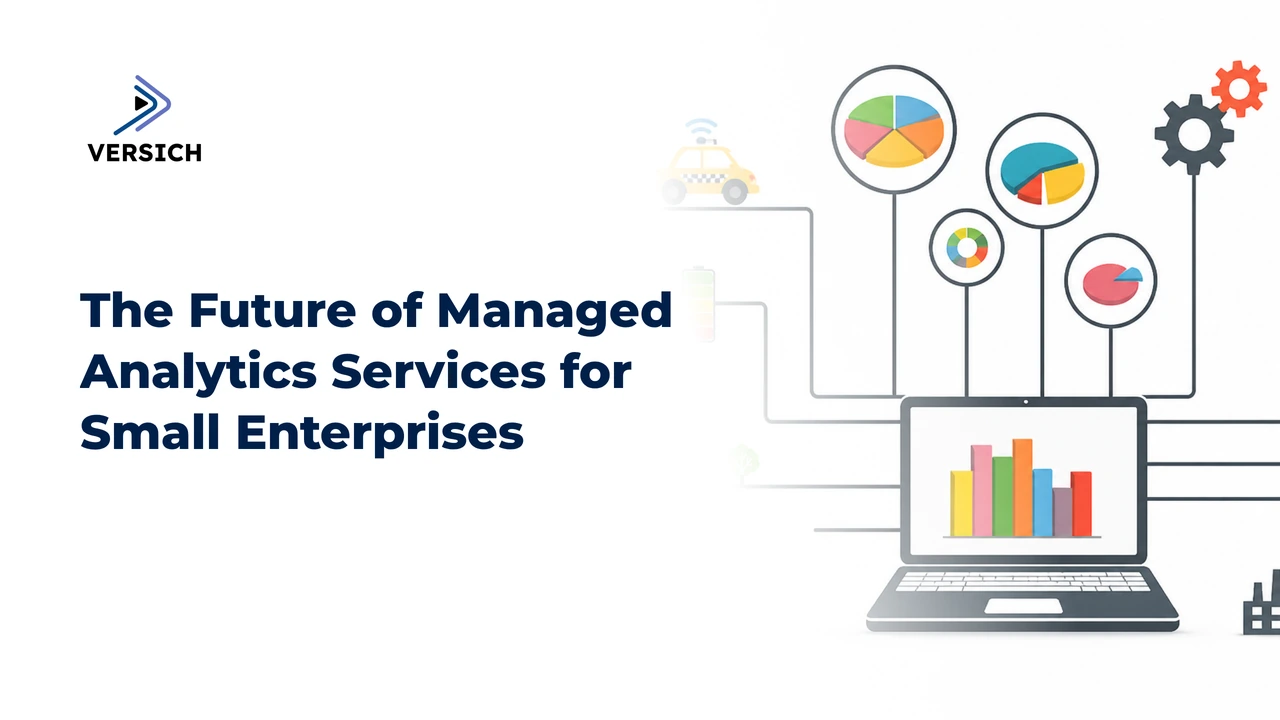
The era of data analytics for small enterprises began in 1999 with the introduction of browser-based CRM solutions. This sector has experienced remarkable growth and is now essential to numerous small enterprises. In this article, we will explore the significance of Managed Analytics Services for Small Enterprises and what lies ahead in this domain.
Access to analytics is crucial for businesses to convert raw data into meaningful insights, identify unseen patterns, reveal new trends, and enhance decision-making. Data analytics can optimize internal operations and boost profitability without sacrificing quality. As organizations face a widening talent gap, managed analytics services are becoming increasingly attractive.
Building and maintaining an in-house data analytics team is often not feasible for small enterprises. Managed analytics services provide a cost-effective and dependable means to obtain actionable insights and remain competitive in the marketplace. Research from Canalys indicates that nearly 90% of business partners anticipate growth in revenue from managed services in 2023, with 56% expecting an increase of over 10%. Additionally, 35% of participants foresee growth exceeding 20%.
These figures suggest a strong future for managed analytics solutions. Let’s delve into what the future holds for data analytics and small enterprises.
In What Ways Does Data Analytics Support Small Enterprises?
A report from NewVantage Partners reveals that 91.9% of businesses tracked measurable outcomes through data and analytics in 2023. The global data analytics market is currently valued at $307.52 billion, expected to rise to $745.15 billion by 2030, with a compound annual growth rate (CAGR) of 13.5%.
Small enterprises often lack the advantages enjoyed by larger, established companies. They must adopt smarter strategies to make an impact within their markets and attract clientele. Data analytics levels the playing field and facilitates more opportunities for small enterprises to navigate uncertainties. Utilizing managed analytics insights offers a competitive advantage, strengthening both systems and processes. Moreover, it assists in the following areas:
Embrace a Data-Centric Philosophy
A data-centric philosophy enables a business to base its decisions on reports generated from analyzing historical and current data. This enhances the company's market position and heightens visibility across various platforms. Businesses gain insights into customer preferences, while target audiences become aware of the business's offerings.
Enhance Clarity and Transparency
Losses stemming from poor clarity or transparency are not an option for small enterprises. Transparency in areas like finances, market distribution, and customer service can minimize miscommunications and misunderstandings within the organization. Data analytics refines workflow, allowing for straightforward tracking of processes.
Improve Closure Rates
A business's survival hinges on its customer base. Data analytics helps monitor customer interactions, identifying areas that require enhancements. Additionally, it offers insights into customer lifetime value, empowering businesses to understand how much to invest in each customer.
Optimize Inventory Management
Ineffective inventory management can lead to issues such as stock shortages during peak demand or excessive unsold inventory. Data analytics streamlines inventory processes and establishes an efficient system. Businesses can leverage analytics to forecast market demand and adjust accordingly.
Grasp Customer Behavior
Many brands struggle to interpret customer behavior. Relying on speculation or outdated data to predict customer needs is insufficient. Data analytics effectively integrates historical and real-time data, yielding more precise insights into customer behavioral trends, thereby enhancing sales opportunities.
Manage Opportunities Proactively
Dissecting business and market data can yield profound insights into current standings and future expectations. Small enterprises must act proactively to seize opportunities before larger brands do, harnessing the potential of data and business analytics.
The Outlook for Managed Analytics Services in Small Enterprises
Predicted to reach $68.9 billion by 2028, the Analytics as a Service (AaaS) market will see managed analytics providers play a crucial role in helping small enterprises integrate data analytics into their operations.
Here are some significant trends anticipated for the future of managed analytics tailored for small enterprises:
Adoption of Multi-Cloud Data Systems
As highlighted in a report by Gartner, cloud computing remains the most favored technology for businesses investing in data and analytics. Small enterprises increasingly rely on cloud solutions for data storage, software operation, and application hosting instead of maintaining an in-house data center, which requires extensive upkeep. Utilizing multiple cloud platforms can also help small enterprises construct a robust data ecosystem.
Focus on Data-Centric AI
Artificial intelligence is no longer confined to large corporations. Small enterprises can effectively harness AI by aligning their investments with a data-centric model over traditional model- or code-centric approaches. More small businesses are likely to adopt generative AI to produce synthetic data for training models and extracting valuable insights.
Integration of Edge AI
Edge AI delivers real-time insights by analyzing data collected from Internet of Things (IoT) devices. This capability aids small enterprises in conforming to data privacy standards while minimizing reliance on complicated data storage infrastructures.
Growth in AI Investments
A recent survey by Gartner revealed that over 2,500 executive leaders reported an increase in AI investments spurred by the popularity of ChatGPT. Small enterprises have the opportunity to capitalize on AI advancements by collaborating with managed service providers.
What are the Upcoming Trends in Data Analytics?
Rise of Data Automation
Automation is currently utilized across various business functions and is expected to become increasingly significant. As businesses seek to avoid dedicating resources to manually process extensive datasets, data automation powered by managed service providers will emerge prominently. For instance, augmented and real-time analytics require the integration of automation and AI technologies.
Emphasis on Data Governance, Privacy, and Security
Companies are transitioning from data warehouses to data lakehouses, which combine the advantages of both data warehouses and data lakes. A data lakehouse serves as a crucial infrastructure to accommodate rising data volumes over time and enables effective management for analytical purposes. Data lakehouses will play a pivotal role in data governance, with a heightened focus on data privacy and security as businesses adopt measures to enhance protection and data integrity.
Advancements in NLP Applications
The use of Natural Language Processing (NLP), deep learning networks, and automated machine learning (AutoML) will increase. The growing popularity of generative AI largely influences the rise of NLP, while AutoML will be used to uncover correlations within extensive datasets. However, achieving desired outcomes necessitates a robust data strategy.
Enhanced Data Visualizations
Data visualization dashboards are critical for interpreting insights visually. Tools such as Power BI, Tableau, and Qlik facilitate the creation of engaging visuals that can be tailored. Advanced visualizations can also be embedded in third-party sites to communicate intricate data effectively.
What is the Future of Business Analytics in Management?
Business analytics serves as a foundation for effective management, streamlining operations, minimizing unnecessary expenses, optimizing resources, and boosting productivity. From improving customer experiences to increasing employee satisfaction, the benefits for an organization are immense. In the future, the business analytics lifecycle is set to:
Decrease cloud-computing expenses through efficient querying methods.
Implement data mesh structures to manage extensive datasets without escalating costs.
Enhance scalability and flexibility through automation.
Foster decision intelligence to minimize gaps in decision-making.
Facilitate data sharing among departments and external partners.
Promote data democratization via generative AI.
Enable managed predictive modeling for real-time analytics without necessitating in-house models.
What Does the Future Hold for the Analytics Industry?
Gartner forecasts that approximately 75% of organizations will shift from pilot projects to full-scale big data implementations by the end of 2024. This transition can potentially increase data and analytics streaming by roughly 500%. Emerging trends in the analytics industry indicate a forthcoming disruption, where businesses will employ analytical tools to navigate global crises without adversely impacting their operations.
Emerging technologies such as 5G, generative AI, and augmented analytics will gain significance, empowering organizations to better identify risks and opportunities. The analytics industry is poised for growth as more small enterprises and large corporations invest in advanced technology and data-centric models.
Conclusion
The impact of data analytics will persist in transforming both small and large organizations. Collaborating with managed analytics providers will aid in the establishment of a comprehensive data strategy across various departments. Small enterprises can adopt proven methodologies to achieve superior results while steering clear of high-risk, low-reward options.
Managed Analytics services offer a cost-effective, flexible, and scalable solution that can be tailored to fit any industry or niche. Small enterprises can expand their growth potential by partnering with managed analytics service providers.