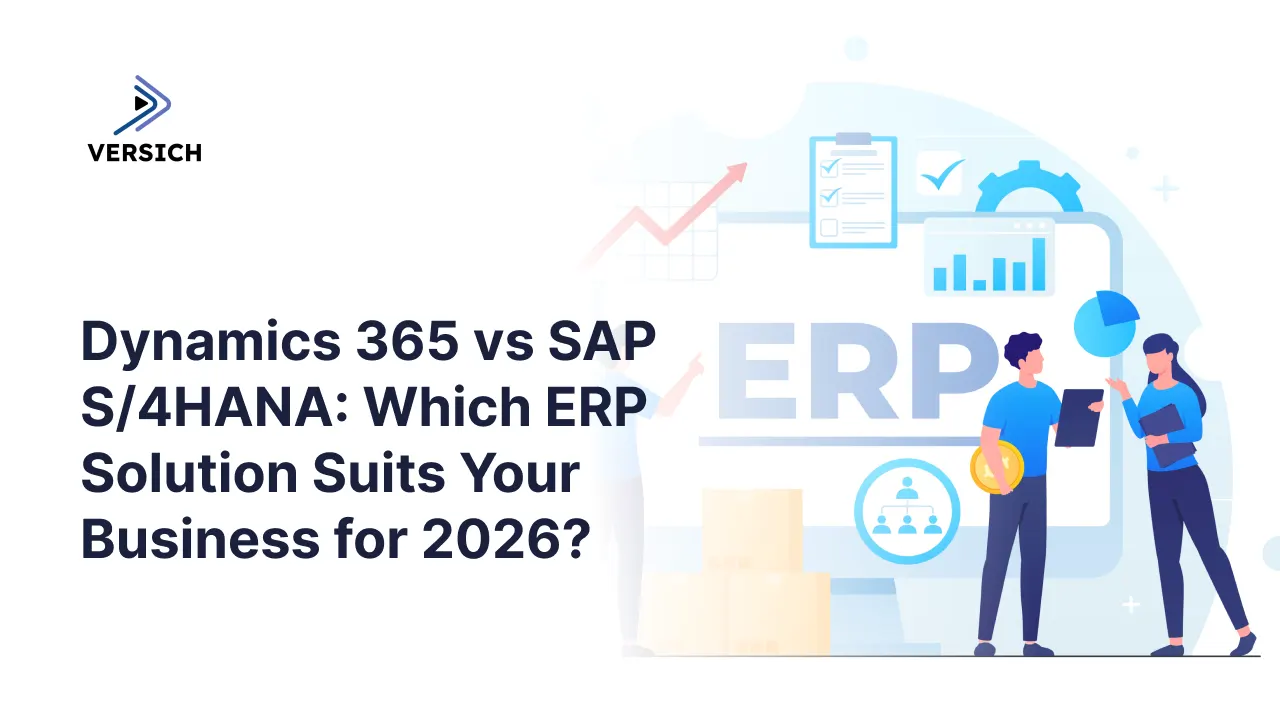
ERP software forms the backbone of any organization, overseeing data and streamlining processes across numerous departments. In this discussion, we will delve into the contrasts between Dynamics 365 and SAP S/4HANA, assisting companies in selecting the ideal ERP software for their operational needs in 2026.
ERP (enterprise resource planning) systems serve as an integrated, centralized platform that optimizes critical functions within an organization. These systems unify data and workflows from diverse areas such as human resources, marketing, finance, sales, logistics, and production, creating a singular, reliable source of information. They facilitate the movement of data across the organization, empowering employees at various levels to make informed, data-driven decisions.
According to The Business Research Company, the market for ERP software was valued at $159.87 billion in 2025 and is anticipated to reach $175.94 billion in 2026, projecting a CAGR (compound annual growth rate) of 10.1% to achieve $258.59 billion by 2030. SAP, Oracle, and Microsoft stand out as the leading contenders in the ERP ecosystem, followed by other notable vendors.
A robust ERP solution integrates seamlessly with third-party analytical and business intelligence tools. These systems can support the data architecture for comprehensive data management and dashboard oversight. Companies specializing in data engineering often oversee ERP software implementation and maintenance, ensuring that a data-driven approach supports executives in harnessing real-time insights for daily operations.
In this article, we will further analyze Dynamics 365 and SAP S/4HANA, the two predominant ERP solutions worldwide, comparing their features to determine which is most suitable for your organization in 2026.
What Function Does Dynamics 365 Serve in a Business?
Dynamics 365 is equipped with AI-driven ERP and CRM applications that empower organizations to manage finance, sales, supply chain, and service functions. These applications can function independently or together, and they can also sync with third-party software for optimal data management and insights. For instance, with Power BI consulting services, CTOs can link Dynamics 365 with Power BI to disseminate business intelligence reports through custom dashboards.
Dynamics 365 plays a crucial role in enhancing organizational processes, which in turn improves decision-making. Its advanced analytics and self-operating agents also contribute to better customer engagement. The real-time data-sharing capability streamlines access for employees across the organization, allowing them to act proactively in their roles. By leveraging AI, Dynamics 365 automates repetitive tasks, conserving time and resources while maintaining high standards of efficiency and quality. The ERP software can be deployed on the cloud, on-premises, or in a hybrid setup, and can scale according to the requirements of a growing enterprise.
What Function Does SAP S/4HANA Serve in a Business?
Initially launched as financial software under the name SAP Simple Finance, SAP S/4HANA has evolved into a comprehensive suite covering a wide range of functionalities. Through ongoing upgrades and enhancements over the years, SAP has added numerous features, machine learning capabilities, and intelligent technologies.
SAP S/4HANA also offers industry-specific solutions tailored for various sectors, including consumer goods, energy and natural resources, public services, financial services, and more specialized industries. Presently, CTOs can combine SAP S/4HANA with Joule, SAP’s proprietary assistant, to facilitate natural language interactions between employees and the software interface.
A report from Business Research Insights values SAP S/4HANA at $51.12 billion in 2026, estimating it will rise to $333.92 billion by 2035 with a CAGR of 26.44%. North America leads in SAP S/4HANA adoption, with Europe closely following. This indicates that SAP S/4HANA is among the top ERP solutions for businesses in 2026, appealing to a multitude of enterprises worldwide.
Experienced firms specializing in data engineering typically work with various software platforms, enabling them to integrate systems effectively and create a dependable, flexible, and scalable IT architecture that enhances business processes and optimizes resource utilization while delivering a strong ROI.
Which ERP System Should You Select: A Comparison of Dynamics 365 and SAP S/4HANA
Dynamics and SAP both function as enterprise ERP solutions that can be implemented on-premises or in a hybrid setting. They offer support for third-party integrations, flexible pricing structures, scalability options, and a vast array of features, making both systems effective for organizations. Nevertheless, they differ significantly in several respects, which we will explore further below.
Which ERP is Best for SMBs: Dynamics 365 vs SAP for Medium Enterprises
Small and medium-sized enterprises typically deal with lower transaction volumes, and their processes, budgets, and requirements are generally more confined, with certain exceptions. In these situations, Dynamics 365 often emerges as the more favorable option.
When comparing Dynamics 365 and SAP S/4HANA, Dynamics has been specifically crafted to meet the needs of smaller businesses and can be adapted for medium enterprises. Moreover, it can be adjusted as needed-both scaling up and down-based on market conditions, growth initiatives, and setbacks.
Additionally, being part of the extensive Microsoft ecosystem, which includes Azure cloud, Power BI, and Fabric, Dynamics 365 can effectively facilitate integrations for data analytics and business intelligence, making it a powerful choice for organizations in this sector.
Which ERP is Superior for Large Enterprises: SAP vs Dynamics 365 for Major Corporations
Large organizations and multinational corporations operate at a scale far beyond that of SMBs. SAP has consistently branded S/4HANA as the ideal ERP solution for larger entities requiring extensive scalability. Industries such as manufacturing, retail, healthcare, public sector, and finance, including both rapidly expanding mid-sized companies and larger enterprises, are central to its target market.
SAP S/4HANA efficiently processes and analyzes large datasets in real-time and includes pre-configured industry-specific functionalities and workflows. Additionally, SAP's open APIs and integration capabilities foster connections with various third-party software solutions.
Moreover, the Financials module in SAP S/4HANA comprises approximately one thousand features, making it an industry standard. Large financial institutions and service providers can adeptly manage data across all tiers by customizing their workflows using these features.
What are the Costs of the ERP Software: SAP vs Dynamics 365 Pricing Overview
The pricing of SAP S/4HANA in comparison to Dynamics 365 varies based on implementation models, customization needs, integrations, and other influencing factors. For instance, SAP has both on-premises and cloud options. The on-premises edition generally necessitates a one-time purchase, where the licensing fee is determined by the number of users and the required functionalities. The cloud version operates on a subscription basis, offering enhanced flexibility and scalability, with hosting options available on platforms like AWS and Azure.
Dynamics 365 follows a subscription-based cloud pricing model. The costs are typically calculated on a per-user, per-month basis, providing great flexibility that can help SMBs manage their budgets better. It also allows CTOs and CIOs to tailor app selections in line with evolving work demands.
Moreover, the total cost of ownership tends to be more predictable with Dynamics compared to SAP, as large companies often face complex deployments and numerous integrations that escalate overall costs and overhead.
What ROI Does ERP Software Deliver: ROI Comparison Between SAP and Dynamics
Dynamics 365 often offers a higher and faster ROI for small and mid-sized businesses, largely due to fewer complicated integrations and connections. The cost of implementing ERP solutions varies significantly between SAP and Dynamics. Dynamics generally incurs lower setup costs and annual maintenance expenses, yielding an approximate return of $17 for every dollar invested.
On the contrary, SAP S/4HANA tends to be pricier upfront. Its initial setup costs can be substantial due to the extensive customization and integrations required. Sufficient internal and external resources, along with training and support, are essential to ensure the infrastructure operates efficiently and meets desired performance benchmarks.
However, it does provide excellent long-term benefits. While the initial ROI may be lower, the potential returns can increase substantially over time, provided the system is optimized and maintained effectively.
What Are the Advantages and Disadvantages of SAP vs Dynamics 365?
SAP S/4HANA
Advantages
Real-time operational visibility
Advanced production planning
Integration of AI features
Comprehensive financial reporting
Availability of both cloud and on-premises models
Disadvantages
Limited customization and scalability
Steeper learning curve for users
High costs associated with implementation
Dynamics 365
Advantages
Enhanced collaboration capabilities
User-friendly interface with easy navigation
Strong operational visibility
Flexible scalability and seamless integration
Inclusion of AI functionalities
Disadvantages
Less effective for managing large datasets
Primarily designed as a cloud-based solution
Initial complications in integrations
Both SAP and Dynamics present their unique strengths and challenges, making each a valuable option depending on specific business needs. They also facilitate automated data pipelines to enhance data flow and deliver ongoing insights.
Which ERP Excels in User Experience: SAP versus Dynamics
When considering user experience between Dynamics 365 and SAP S/4HANA, it largely depends on the expertise of the existing personnel within your organization. S/4HANA employs SAP's Fiori UX, which aims to provide a more tailored, user-friendly, and engaging interface across devices. However, it still necessitates a learning period. Employees may benefit from training programs to fully leverage SAP in their daily tasks.
Conversely, Dynamics 365 offers a straightforward and efficient interface with a less intensive learning curve. Microsoft focuses on clean and intuitive navigation, allowing for smoother workflows. Furthermore, employees can easily access data through Dynamics even from other platforms, such as Teams and Outlook, and can create data visualization reports via Power BI dashboards.
Conclusion
Determining the most suitable ERP solution between Dynamics 365 and SAP S/4HANA depends on the size of your organization, operational complexity, industry-specific requirements, budget constraints, and scalability needs. Both solutions are capable and deliver exceptional results when optimally deployed.
Engagement with a qualified business intelligence consultant can help identify the most suitable ERP software, hosting plan, pricing structure, and functionalities to match your specific needs. Planning for the long term is crucial to future-proofing your business and securing viable returns. The right ERP system not only enhances overall efficiency but also boosts customer satisfaction.
More on Data Engineering Services
Our data engineering services encompass comprehensive solutions for data collection, cleansing, transformation, storage, analytics, and management. These services include data modeling, automation of data pipelines, deploying data architecture, data warehousing, business intelligence, and creating customized dashboards.
Establishing connections with ERP, CRM, HRMS, and other third-party applications is integral to data engineering, promoting effective data flow across different systems. With tailored data engineering solutions, enterprises can make informed, proactive decisions and gain a competitive advantage in the global market.