Introduction
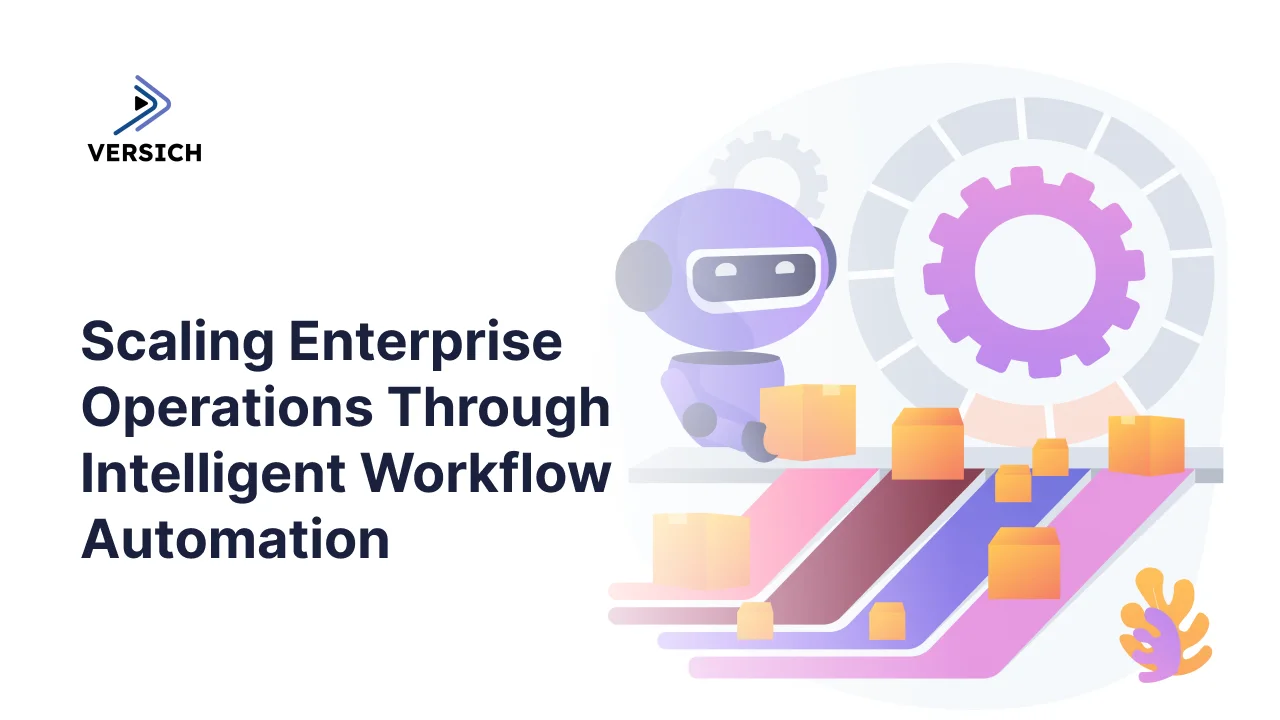
Enterprise growth has a way of exposing every manual process a business has been quietly tolerating. What worked when a finance team had three people and a handful of vendors starts to buckle when transaction volumes triple, new subsidiaries come online, or a company expands into new markets. At Versich, we see this pattern constantly across the NetSuite, Power BI, and ERP environments we support. The businesses that scale smoothly are not the ones with the most headcount. They are the ones that have replaced fragile manual workflows with intelligent automation that connects systems, enforces consistency, and frees people to focus on judgment calls rather than data entry.
This is the conversation we have with growing organizations every week. Order-to-cash cycles that depend on someone remembering to update a spreadsheet. Approval chains that stall because an email got buried. Vendor records that need the same five fields populated by hand every single time. None of this is a technology failure in the traditional sense. It is a workflow design problem, and it is exactly the kind of problem intelligent automation is built to solve.
In this article, we walk through what intelligent workflow automation actually means at enterprise scale, where it delivers the most value, and how we approach building automation that holds up under real operational pressure rather than breaking the first time a process changes.
We also want to be upfront about something we tell every client before a project starts. Automation is not a shortcut around process discipline. It is an amplifier. A well designed workflow that gets automated becomes faster, more consistent, and easier to audit. A poorly designed workflow that gets automated just produces bad outcomes faster and at greater scale. The work we do is as much about clarifying how a process should actually run as it is about the technical build that makes it run automatically.
What Intelligent Workflow Automation Really Means
Workflow automation is often reduced to a narrow idea: a trigger fires, a task happens, done. That definition works for simple notifications, but it falls apart at enterprise scale where workflows touch multiple systems, require conditional logic, and need to handle exceptions gracefully rather than just failing silently.
We define intelligent workflow automation as the combination of three things working together:
- Process orchestration that connects data and actions across multiple systems, not just within one
- Decision logic that can route, branch, or escalate work based on real business rules, not just static if-then statements
- Visibility and control that let operations teams see what is happening, intervene when needed, and trust the output without manually checking it
This is the lens we apply whether we are scripting inside NetSuite, building a Power BI reporting layer, or designing an automation flow in n8n. The goal is never automation for its own sake. It is removing friction from a process while keeping it auditable and predictable.
There is also an important distinction between automating a task and automating a workflow. A task automation might simply move a file from one folder to another on a schedule. A workflow automation understands the broader context, checks conditions, makes routing decisions, and knows what to do when something does not match expectations. Enterprises rarely struggle with single tasks. They struggle with workflows that span departments, systems, and approval chains, and that is where the real complexity, and the real opportunity, lives.
Where Manual Processes Break Down at Scale
Most enterprises do not plan to run on manual workarounds forever. They accumulate them gradually, usually because a quick fix solved an immediate problem and nobody circled back to automate it properly. The table below summarizes the patterns we see most often, and what they tend to cost an organization as volume increases.
Manual Process | Common Symptom at Scale | Operational Cost |
Vendor and customer onboarding | Inconsistent subsidiary, currency, or tax fields | Rework, compliance risk, delayed payments |
Approval routing | Approvals sitting in inboxes for days | Slower close cycles, vendor frustration |
Cross-system data entry | Same data typed into two or three platforms | Data mismatches, reconciliation overhead |
Reporting and dashboards | Analysts manually exporting and rebuilding reports | Stale data, wasted analyst hours |
Exception handling | No clear owner when something goes wrong | Issues sit unresolved until they escalate |
None of these issues are dramatic on their own. A delayed approval here, a mismatched record there. The damage comes from the accumulation. By the time a business is processing thousands of transactions a month, the friction in these manual steps compounds into real revenue leakage and slower decision making.
We have also noticed that manual workarounds tend to become invisible to leadership precisely because they work, most of the time. A finance team finds a way to close the books even with broken processes underneath, because people are good at compensating for bad systems through sheer effort. The problem only becomes visible when that effort runs out, usually right when the business is scaling fastest and can least afford the disruption. Part of our job is surfacing those hidden workarounds before they become a crisis rather than after.
Designing Automation That Scales With the Business
We have learned, often the hard way on legacy systems we have inherited from other vendors, that automation built without a clear design philosophy becomes its own liability. A workflow that works perfectly at low volume can collapse under real enterprise load if it was never designed with scale in mind. Our approach to building automation that holds up over time rests on a few core principles.
Build for exceptions, not just the happy path
Every workflow has an ideal scenario where everything goes right. Real businesses do not run on the happy path. We design automation that explicitly handles missing data, failed API calls, and conflicting records, with clear logic for what happens next rather than letting the process fail without explanation.
Keep logic centralized and visible
Automation that is scattered across email rules, spreadsheet macros, and undocumented scripts becomes nearly impossible to maintain. We centralize workflow logic in systems built for it, whether that is native NetSuite scripting, a dedicated automation platform, or a well-documented integration layer, so the business always knows where the rules actually live.
Design for change from day one
Business rules change. Approval thresholds shift, new subsidiaries get added, tax requirements evolve. We build automation with configuration points rather than hard-coded values wherever possible, so updates do not require rebuilding the workflow from scratch.
Measure before and after
We are cautious about automation projects that skip the measurement step. Without a clear baseline for cycle time, error rate, or manual hours spent, it becomes impossible to prove the automation actually delivered value, and it becomes much harder to justify the next phase of investment to leadership. We build measurement into the rollout itself rather than treating it as an afterthought.
Where We See the Biggest Wins in Enterprise Automation
Not every process deserves the same level of automation investment. We typically prioritize the workflows below first, because they tend to deliver the fastest and most measurable return for growing enterprises.
Workflow Area | Automation Opportunity | Typical Impact |
Procure-to-pay | Automated PO matching, vendor record validation, approval routing | Faster cycle times, fewer payment errors |
Order-to-cash | Automated invoicing triggers, credit checks, fulfillment updates | Improved cash flow, fewer billing disputes |
Financial close | Automated reconciliation, journal entry creation, reversal handling | Shorter close, fewer manual adjustments |
Reporting and analytics | Scheduled data refreshes, automated dashboard distribution | Real-time visibility for leadership |
System-to-system sync | Automated record creation across ERP, CRM, and finance tools | Elimination of duplicate data entry |
In our own client work, these are consistently the areas where automation pays for itself quickly. A procure-to-pay process that used to require manual touchpoints at every stage can run with exception-only human review once the right logic is in place, and the same is true across most of the workflow categories above.
It is worth noting that the size of the win is not always proportional to the size of the technical build. We have implemented relatively small automations, such as auto-assigning subsidiary and currency fields on new vendor and customer records, that eliminated a recurring source of errors a finance team had been manually correcting for years. The lesson we keep relearning is that the highest value automation often targets the most repetitive, least glamorous step in a process, not the most technically impressive one.
The Role of Connected Systems and APIs
Intelligent automation rarely lives inside a single application. Most of the value comes from connecting systems that were never designed to talk to each other natively. An ERP needs to share data with a CRM. A finance platform needs to feed a business intelligence tool. A vendor portal needs to push records into an accounting system without anyone re-keying information.
This is where solid API architecture becomes the foundation everything else is built on. Automation that connects fragile, undocumented integrations tends to break the moment one system changes a field name or updates an authentication method. We build integrations designed for the long term, with proper authentication, error handling, and monitoring, so the automation layered on top of them stays reliable.
We also pay close attention to how an API is documented and maintained after launch, not just how it performs on day one. An integration that nobody on the internal team understands a year later becomes a liability the moment the original developer moves on. Our approach favors clear documentation, sensible versioning, and security practices that hold up to scrutiny, because the APIs connecting your core systems deserve the same rigor as the systems themselves.
If your enterprise needs custom, secure, and scalable APIs to connect core systems, our API Development Services page
Workflow Orchestration With n8n
For businesses that need automation spanning multiple platforms, cloud services, and internal tools, we frequently build orchestration layers using n8n. It gives us a flexible way to design multi-step workflows with conditional branching, error handling, and scheduled triggers, without locking a business into a single vendor's ecosystem.
We have used this approach for workflows including:
- Automated vendor and customer onboarding that validates data before it reaches the ERP
- Cross-platform notifications that route approvals to the right team based on dollar thresholds or department
- Scheduled data syncs between cloud applications that do not have native integrations
- Exception alerts that flag failed transactions for human review instead of letting them disappear
n8n works well precisely because it is visual enough for our team to design and maintain quickly, while still being powerful enough to handle the conditional logic that real enterprise workflows demand. For businesses already running on a patchwork of point-to-point integrations, this kind of orchestration layer is often the fastest path to a system that behaves predictably end to end.
To see how we approach this in more depth, visit our n8n Workflow Automation Services page
Turning Automated Data Into Decisions With Power BI
Automation solves the problem of moving and processing data correctly. It does not automatically solve the problem of understanding that data. Once workflows are automated and clean data is flowing reliably between systems, the next step is making that data visible and actionable for the people who need to make decisions from it.
This is where we bring Power BI into the picture. We connect automated data pipelines directly into dashboards that give finance leaders, operations managers, and executives a live view of what is actually happening in the business, rather than a snapshot pulled together manually once a month.
- Real-time visibility into procure-to-pay and order-to-cash cycles
- Automated refresh schedules so dashboards never go stale
- Drill-down reporting connected directly to ERP and operational data
The combination of automated workflows and automated reporting is what actually changes how a business operates day to day. Decisions get made on current data instead of last quarter's export. When the underlying automation is sound, the reporting layer stops being a monthly scramble and becomes a dependable part of how the business runs.
You can learn more about how we design and build these dashboards on our Power BI Consulting Services page
A Practical Path Forward for Growing Enterprises
Businesses considering workflow automation often ask where to start, particularly when there are dozens of manual processes competing for attention. We generally recommend a phased approach rather than trying to automate everything at once.
Phase | Focus | Goal |
Assess | Map current manual workflows and identify bottlenecks | Build a clear, prioritized picture of where automation will help most |
Stabilize | Clean up underlying data and system integrations | Ensure automation has reliable data to work with |
Automate | Build and deploy workflow automation for priority processes | Remove manual touchpoints and reduce cycle times |
Monitor and refine | Track performance and adjust logic as the business changes | Keep automation aligned with evolving business rules |
This phased approach avoids the common trap of automating a broken process and simply making the breakage happen faster. Getting the underlying data and system connections right first is what allows automation to actually deliver the reliability enterprises are looking for. We have found that businesses who resist the urge to skip straight to the automate phase end up with workflows that need far less rework down the line, simply because the foundation was solid before the automation was layered on top of it.
Conclusion
Scaling enterprise operations is rarely about adding more people to handle more volume. It is about removing the manual steps that do not need a human judgment call, so the people on your team can focus on the decisions that actually require their attention. Intelligent workflow automation, built on solid integrations, reliable APIs, and clear reporting, is what makes that possible.
At Versich, we help growing businesses design and implement automation that holds up under real operational pressure, whether that means scripting directly inside NetSuite, building orchestration flows in n8n, developing custom APIs to connect critical systems, or layering Power BI dashboards on top of it all so leadership can see the results in real time.
We have seen this combination change how an enterprise operates within a single budget cycle. Approval delays shrink. Reconciliation errors drop. Reports that used to take an analyst a full day to assemble update automatically every morning. None of it happens overnight, and none of it happens without a clear plan, but the businesses willing to invest in getting the foundation right consistently outscale the ones still relying on manual effort to hold their operations together.
If you are ready to talk through where automation could make the biggest difference in your operations, we would welcome the conversation. Visit our Contact Us page