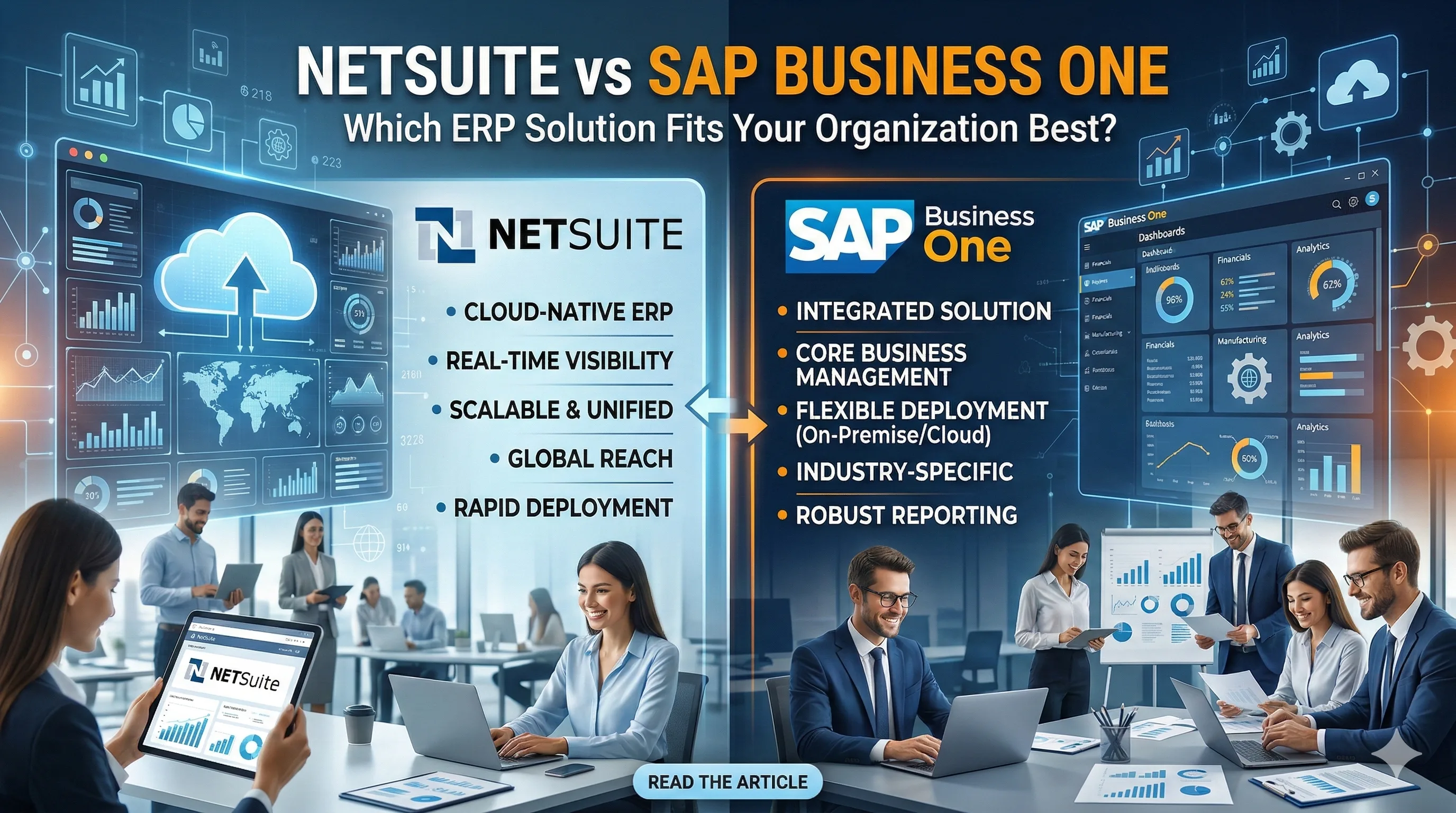
Businesses today are increasingly aware of the benefits an ERP system offers, especially one that operates in the cloud, and many are feeling the pressure to make a switch. Companies understand that outdated practices are ill-suited for the demands of the contemporary business landscape. Consequently, they are taking proactive measures to build a solid foundation for future growth and success. This NetSuite vs. SAP Business One comparison seeks to illuminate both the commonalities and unique features presented by these sophisticated business software solutions. To achieve the clarity, adaptability, visibility, and agility essential for growth, organizations must modernize their entire IT infrastructure.
This article explores the primary features and functions of both NetSuite and SAP Business One. Traditional on-premise solutions are often inadequate for meeting the evolving demands of today's businesses. SAP Business One has transitioned from a legacy system to a cloud-ready option, but it still relies on a complex IT framework that often hinders business continuity. In contrast, modern SaaS solutions facilitate a unified data model, leading to better-informed decision-making. According to Gartner, “Cloud is the single most influential technology in IT today.” By early 2022, over half of global organizations were expected to adopt a cloud-first approach. Organizations adopting this strategy gain greater benefits from the software's architecture rather than solely its individual components, resulting in faster deployments, reduced risk, lower costs, and enhanced speed, reliability, and scalability. Cloud-based ERP solutions enable companies to react quickly to changing market dynamics.
What’s the Better Choice: NetSuite or SAP Business One?
ERP tools like SAP and NetSuite are designed to automate core business functions, including inventory management, accounting, and customer relationship oversight. While there are notable differences that potential users should consider, they also share many similarities.
In terms of technology, SAP is still striving to keep pace. Both SAP and NetSuite have upgraded to offer cloud-based ERP offerings, but SAP's capabilities have been in development for approximately nine years, whereas NetSuite has established itself as a pioneer in cloud ERP for over two decades. Let’s delve deeper to discover whether SAP truly outshines NetSuite.
NetSuite
Launched in 1998, NetSuite has always been built as a cloud-centric solution. It encompasses features for financial oversight, inventory management, HR functions, ERP, CRM, PSA, and eCommerce. NetSuite ensures seamless and rapid mobile access while integrating easily with existing software systems. It provides advanced customization capabilities and real-time analytics, making it ideal for businesses of all sizes, from small local firms to large multinational corporations.
SAP Business One
In 2012, SAP introduced a cloud-friendly version of its originally in-house program. Its user-friendly interface contributed to its popularity. While SAP Business One does support mobile access, it’s not as smooth as NetSuite's offerings. However, SAP does have integration capabilities and instant analytics, albeit with certain limitations.
SAP Business One: Specifically designed for small enterprises, initially as an on-premise solution, now available in the cloud, intended for businesses with 5 to 100 users.
SAP Business By Design: Tailored for mid-market companies, this ERP system is fully cloud-dependent and suited for businesses with 20 to 1,000 users.
SAP S/4HANA: The most advanced option by SAP, offering superior analytics, AI, and machine learning capabilities to enhance areas like production, revenue generation, and sustainability initiatives.
NetSuite Compared to SAP Business One
Here are key distinctions between NetSuite and SAP:
1. Deployment Differences
The deployment methods for NetSuite and SAP show substantial differences. Initially, SAP Business One was an on-premise solution. Since its cloud introduction in 2012, it aims to offer greater flexibility and innovation. In contrast, NetSuite has consistently operated as a cloud-based ERP, implemented for over 18,000 clients over its historic 25 years.
Bottom line: NetSuite tends to facilitate simpler adoption due to its historical focus on cloud architecture, streamlining the implementation process. Generally, NetSuite has a quicker go-live timeframe, though implementation timelines for any ERP solution depend on company-specific adjustments.
2. Integration Capabilities
For any ERP system, seamless integration with third-party applications is vital. NetSuite provides a diverse set of add-ons and integration options through pre-built APIs like SuiteTalk and RESTlets. Integrations with platforms like Salesforce, Shopify, HubSpot, and Celigo are readily available.
However, the integration process can become costly due to the requirement for specialized development. SCS Cloud offers a range of pre-built NetSuite solutions to streamline integration.
SAP Business One does provide various add-ons and access to data yet lags behind the breadth of NetSuite’s integration capabilities. While it offers SQL-based connections, the options for pre-configured integrations include platforms like Shopify, Magento, UPS, MailChimp, and Salesforce.
Bottom line: If your organization seeks extensive modifications or multiple integrations outside the standard offerings, NetSuite could be a more suitable choice. SAP Business One's integration capabilities may not meet your unique needs, although SAP S/4HANA boasts advanced integration potential-though possibly at a higher cost.
3. Customization Capabilities
NetSuite provides a significantly broader range of built-in customization options compared to SAP Business One. Users can modify dashboards, reports, saved searches, and more to match their exact needs. For more extensive modifications, collaboration with a skilled NetSuite partner is recommended.
While SAP Business One does allow for some code suggestions, its options are more limited. Additionally, users must purchase SAP Crystal Reports to create specific custom reports.
Bottom line: Both NetSuite and SAP Business One allow dashboard customization. While some users find SAP's dashboard slightly more intuitive, both systems enable personalized settings. Reports indicate that modifications in SAP Business One might lead to challenges during software updates, potentially disrupting ongoing processes.
4. Software Features Comparison
NetSuite comes packed with a broad array of functionalities, including eCommerce, ERP, PSA, and HR management. Key features encompass data analytics, payroll, lead management, employee centers, eCommerce transactions, inventory oversight, project management, and procurement tasks.
Although SAP Business One offers similar functionalities, some significant features require additional licenses. For eCommerce integration, users need SAP SuccessFactors and SAP Commerce Cloud.
Bottom line: If your organization requires extensive modifications and integrations, NetSuite is the clear front-runner. SAP Business One may become considerably more expensive when adding functionalities like eCommerce and HR Management, as these tools are bundled with NetSuite.
5. Update Processes
NetSuite implements automatic updates, limiting user control over timing, which can be inconvenient if updates disrupt existing integrations or customizations. Conversely, SAP Business One allows customers to plan updates, ensuring they occur at less critical times, reducing disruption risks. However, updates can also impact customizations, requiring developer assistance to restore settings.
Bottom line: SAP Business One offers greater flexibility regarding software updates, while NetSuite's automatic updates leave less room for user scheduling.
6. Reporting Features
NetSuite comes with extensive reporting capabilities right out of the box, allowing for customized, drill-down reports that facilitate data-driven decision-making. Users can create relevant dashboards and visualizations based on real-time data.
SAP Business One has a robust reporting system, but it requires the SAP Crystal Reports add-on for advanced customizations, which adds $495 per user.
Bottom line: Your specific reporting needs will ultimately dictate the superior option. SAP Business One has added limitations, and substantial adjustments often necessitate an additional licensing fee for add-ons.
NetSuite vs SAP Business By Design
SAP Business By Design does not offer the same comprehensive features as NetSuite. If HR management or eCommerce functionalities are essential, NetSuite remains the stronger choice. To leverage all of NetSuite's advantages with SAP Business By Design, additional licenses for SuccessFactors and SAP Commerce Cloud would be necessary. While SAP ByD is expected to be an out-of-the-box solution, some users claim it offers simpler setup than NetSuite. If your requirements do not necessitate customizations or extensive integrations, it can lead to quicker deployments.
A key benefit of NetSuite is its scalability, accommodating businesses ranging from small operations to large organizations effortlessly. For SAP to match NetSuite's effectiveness, additional effort, licenses, and add-ons may be needed.
NetSuite vs SAP S/4HANA
The enterprise resource planning system SAP S/4HANA aims to deliver enhanced data processing, AI capabilities, analytics, and overall improvements compared to previous SAP offerings. It has become one of SAP's flagship offerings and represents a more premium option. S/4HANA can be configured for on-premises use, cloud deployment, or a hybrid approach.
SAP claims the software was designed to "assist businesses in adopting new business models" and to utilize predictive AI to enhance profitability. While some sectors may prefer SAP S/4HANA for its tailored functionalities, it could also lead to substantially higher costs in comparison to a NetSuite implementation.
Top 6 Reasons Why NetSuite Excels Over SAP
NetSuite shines as a modern, cloud-native ERP solution, known for its user-friendliness, scalability, and ability to support fast-growing businesses. In comparison to SAP, NetSuite provides superior flexibility, simpler customization, enhanced cloud capabilities, and advanced reporting, all via an intuitive interface. Here’s how NetSuite outshines SAP:
1. Intuitive Customization Without Complicated Coding
NetSuite enables users to customize the system to fit specific business needs using straightforward, point-and-click tools. SAP Business One, however, requires a separate tool (MS Visual Studio) and technical support even for minor changes, making it a more complex and time-consuming endeavor.
2. Authentic Cloud-Based ERP
NetSuite was designed as a cloud-native solution from the outset. The same cloud version is used by over 29,000 businesses, ensuring automatic updates and scalable growth. In contrast, SAP still leans on hosted models and enjoys fewer cloud users.
3. Instant Reporting with Drill-Down Options
NetSuite’s single database allows instant generation of personalized reports with drill-down features, providing quicker insights across the business. SAP necessitates an additional software package (SAP Crystal Reports) for custom reports and lacks the robust drill-down elements included with NetSuite.
4. Transparent, Fixed-Pricing Implementation
NetSuite offers straightforward fixed-price implementation packages, helping companies to manage budgets effectively. In contrast, SAP implementations often require custom solutions for transactions, which can lead to unexpected expenses and delays.
5. Uniform and User-Friendly Interface
NetSuite presents a coherent, easy-to-navigate interface across all modules. SAP has made efforts to unify its interface, but the reliance on various tools and products can lead to user confusion, detracting from a seamless experience.
6. All-in-One Solution for Expanding Companies
NetSuite amalgamates ERP, CRM, eCommerce, and real-time dashboards into one platform. There’s no need for multiple systems, which allows complete operational visibility. Businesses enjoy automation, swift data access, and the capability to make informed, data-driven decisions without heavy IT overhead.
Final Thoughts: Which ERP Solution Suits You Best?
Choosing between NetSuite and SAP isn’t straightforward; the right choice depends on your organization's specific requirements. Factors to consider include necessary integrations, add-ons, modifications, deployment preferences, and the implementation partner.
NetSuite clearly leads the industry for small to mid-sized businesses, firmly established in the cloud ERP landscape while steadily increasing its market presence. SAP's pathway to remaining competitive required significant acquisitions, as it has never focused entirely on mid-market cloud ERP solutions. NetSuite, built for the cloud from its inception, remains hard to beat in terms of platform depth, flexibility, ecosystem, and cost.