Is your expanding business facing challenges in coordinating operations across multiple subsidiaries, regional offices, or recently acquired entities? Do your teams grapple with disjointed systems, manual data input, and sluggish reporting, resulting in mismatched data sent to corporate headquarters? As businesses grow globally or diversify through acquisitions, a common dilemma arises: How can you keep centralized control while granting local teams the flexibility to operate effectively? Mandating every branch or subsidiary to adopt a complex, corporate-level ERP solution can be slow and disruptive. Instead, you can achieve local adaptability combined with global oversight by utilizing a robust Tier 1 ERP at the headquarters and a more nimble, cloud-based option like NetSuite at the subsidiary level. This blog delves into why NetSuite stands out as an excellent choice for two-tier ERP implementation.
What is Two-Tier ERP with NetSuite?
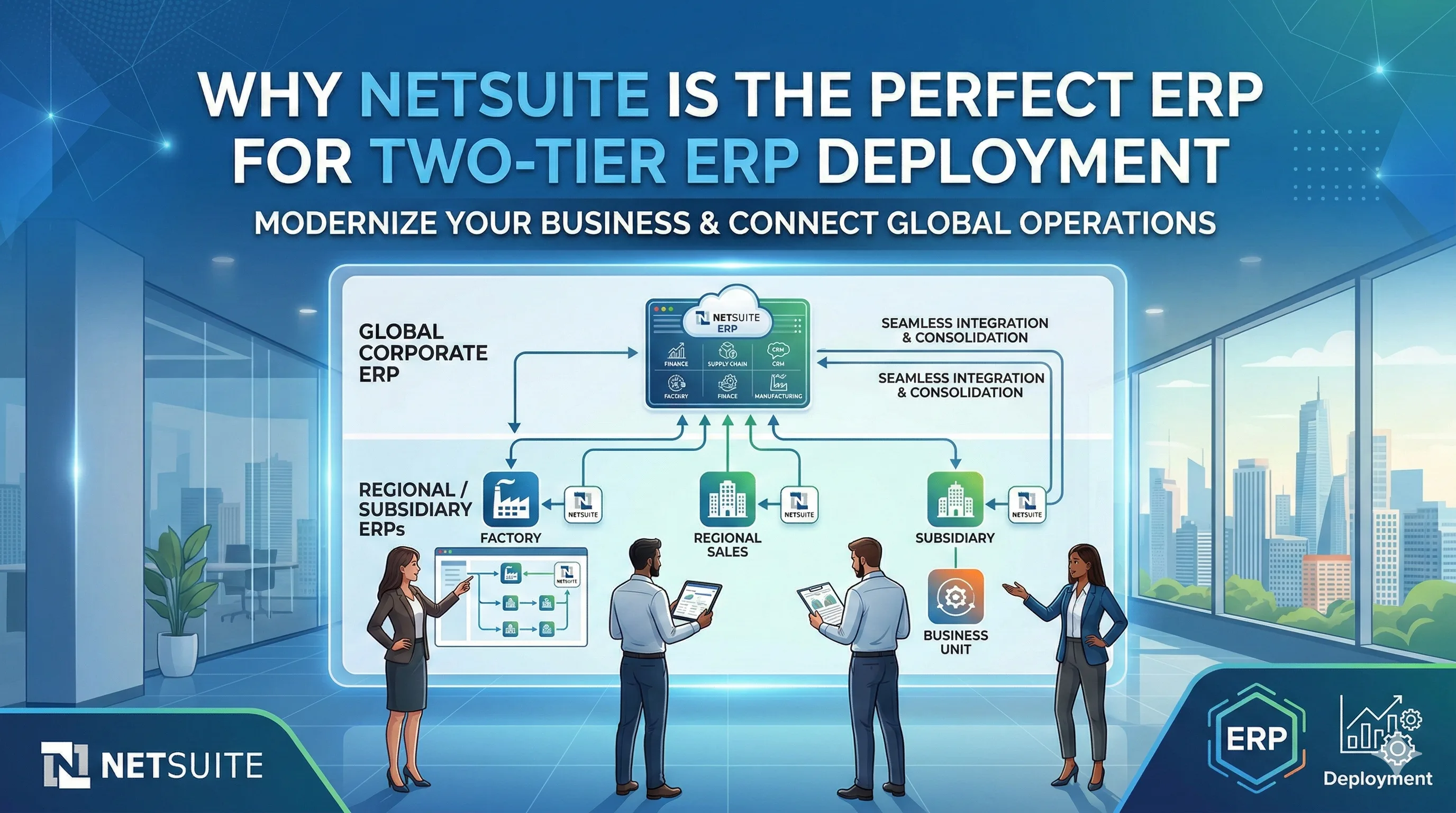
Two-tier ERP refers to a strategic approach used by large organizations with numerous branches or smaller entities under their umbrella. In this setup, the central office employs a sophisticated ERP system, known as Tier 1, which handles critical functions like finance, human resources, and procurement. Meanwhile, the subsidiaries utilize a separate, more straightforward ERP solution identified as Tier 2. This Tier 2 system is cost-effective, user-friendly, and addresses local operations such as sales, inventory management, marketing, or production tasks. Both ERP systems interconnect, allowing information from the smaller units to seamlessly integrate with the primary system. This ensures everyone operates with the same accurate data, keeping all segments of the organization synchronized. It's especially helpful when a large company acquires a new business and needs to integrate it quickly without substantial alterations.
Tier 1 vs. Tier 2 ERP
ERP systems are designed to meet the needs of different business sizes. Tier 1 ERP systems cater to large global firms requiring advanced features and manage various departments. While these systems offer significant capabilities, they are often costly, take considerable time to implement, and demand specialized IT support. They oversee essential functions across the entire organization, including budgeting, reporting, and human resources management.
Conversely, Tier 2 ERP systems are aimed at small to medium-sized enterprises or minor divisions of larger firms. They are generally more affordable, quicker to install, and easier to utilize. Often, Tier 2 ERP solutions come with pre-configured features tailored for specific industries, such as retail or manufacturing. This means daily operations like order tracking, inventory oversight, and local sales processing can be handled efficiently. Therefore, a business might deploy a Tier 1 ERP for its main office while utilizing a Tier 2 ERP like NetSuite for its subsidiaries, achieving efficiency, reducing costs, and maintaining agility-making it ideal for multinational organizations.
Top 6 Advantages of Two-Tier ERP Implementation with NetSuite
As companies grow through new branches, acquisitions, or geographical expansions, managing operations across different units can become complex. Two-Tier ERP with NetSuite streamlines these challenges by pairing a powerful system at the headquarters with an agile cloud-based solution at the subsidiary level. NetSuite is well-suited for this model due to its scalability, ease of integration, and localized control while still providing centralized reporting. Here are the advantages of NetSuite ERP implementation in a two-tier setup:
1. Seamless Integration with Existing Systems
NetSuiteoffers advanced integration tools enabling smooth connections with your Tier 1 ERP system at the corporate level. This ensures automatic data sharing between the main office and local entities, synchronizing financial data, performance metrics, and reports in real time for enhanced transparency and accuracy, minimizing manual tasks and errors. This creates a unified source of truth for the entire organization.
2. Cloud-Based and Scalable
Being a cloud-centric solution, Two-Tier ERP with NetSuite can be easily deployed across various locations without needing complex IT infrastructure or support. Its scalable architecture accommodates your business's growth-whether through opening new offices or acquisitions-without disrupting core operations. Furthermore, it grants immediate access to information from anywhere, streamlining system management and enabling swift reactions to market changes and business needs.
3. Comprehensive Functionality in One Platform
NetSuite provides a full suite of ERP features, encompassing financials, inventory, order management, procurement, CRM, and more within a single platform. It manages entire business processes without requiring separate tools. Additionally, industry-specific versions enhance value by offering pre-built functionalities tailored to your sector, which boosts efficiency and meets the unique demands of various business units.
4. Automation of Key Business Operations
NetSuite streamlines numerous daily business processes, including procurement, invoicing, bank reconciliations, and financial closings. This reduces manual effort, minimizes errors, and enhances speed. For subsidiaries operating with smaller teams, this is invaluable, allowing them to function effectively while providing timely and accurate reports to the central office in a Two-Tier ERP framework.
5. Flexibility for Diverse Business Needs
NetSuite is remarkably flexible, allowing it to adapt to different workflows, business models, and industry requirements across subsidiaries. Whether your unit focuses on manufacturing, distribution, or services, NetSuite can be tailored easily to meet specific needs. This adaptability helps local teams operate efficiently while aligning with corporate goals, making NetSuite an excellent choice for varied and expanding organizations pursuing a two-tier ERP implementation.
6. Vendor Support and Ecosystem
Backed by Oracle, NetSuite benefits from ongoing development, a robust global infrastructure, and dedicated customer care. Additionally, it boasts a wide ecosystem of NetSuite implementation service partners, industry extensions, and certified advisers, providing businesses with expert support throughout the installation, customization, and maintenance processes. This reduces risks and simplifies implementation during multi-unit or global ERP rollouts.
Conclusion
Adopting a two-tier ERP approach can simplify global operations, lower costs, and enhance visibility across various business units. However, choosing the right ERP solution is crucial for achieving success, and NetSuite ranks among the top options. Its cloud-based design, seamless integration capabilities, industry-specific functionalities, and intuitive interface make it an ideal Tier 2 ERP solution. From addressing local compliance needs to real-time data synchronization with your Tier 1 ERP system, NetSuite covers all essential aspects.
Businesses need to begin by thoroughly understanding their subsidiaries' requirements to facilitate successful implementation. This includes determining what data to manage, which processes to support, and how information will flow between headquarters and local units. Important considerations also include usability, expertise, overall cost of ownership, and the ability to scale as your organization evolves.