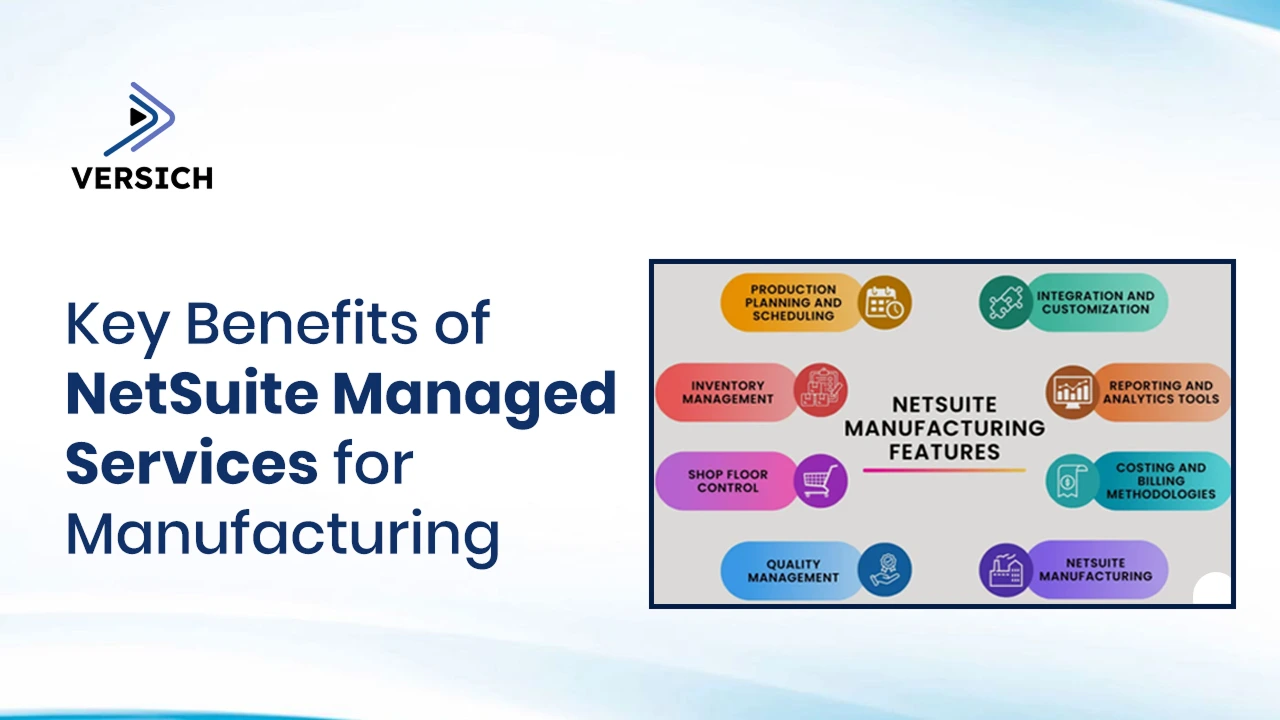
Manufacturing companies operate in a world of tight margins, complex supply chains, and demanding customers. Enterprise systems like NetSuite help manage this complexity, but only if they are configured, maintained, and evolved correctly. NetSuite Managed Services ensure manufacturers get consistent performance, accurate data, and continuous improvement from their ERP, instead of treating it as a one-time implementation that slowly degrades over time.
1. End-to-End Visibility Across the Production Cycle
Manufacturers depend on real-time visibility into inventory, work-in-progress, procurement, and shipments. NetSuite Managed Services help keep that visibility clean and reliable by continuously tuning dashboards, saved searches, and reports for production, planning, and finance users.
Production managers see up-to-date work orders, capacity, and bottlenecks.
Planners can forecast material requirements more accurately and reduce stockouts or overstock.
Finance teams gain confidence that costs, margins, and variances in NetSuite reflect what is actually happening on the shop floor.
This end-to-end visibility helps leadership move from reactive firefighting to proactive planning.
2. More Accurate Costing and Margin Control
For manufacturers, small errors in costing can compound quickly. Misconfigured BOMs, routing, overhead rates, or work order completions can lead to inaccurate margins and misinformed pricing decisions. NetSuite Managed Services regularly reviews and optimizes costing setups, so the ERP reflects true production realities.
Costing methods are validated and aligned with how the business actually runs.
Variance analysis becomes more meaningful because data quality improves.
Product, customer, and plant-level profitability is easier to track and act on.
With better costing, manufacturers can protect margins, adjust pricing with confidence, and decide which product lines deserve more investment.
3. Stronger Inventory Management and Demand Planning
Effective inventory management is critical in manufacturing, especially when dealing with long lead times, multiple warehouses, or contract manufacturing partners. NetSuite Managed Services help configure and refine item records, planning parameters, and replenishment rules.
Safety stock, reorder points, and lead times are monitored and adjusted as patterns change.
Planners gain better suggestions from MRP and demand planning, instead of fighting noisy or outdated data.
Slow-moving and obsolete inventory is easier to identify and reduce.
Over time, this leads to lower carrying costs, fewer stockouts, and a smoother, more predictable production rhythm.
4. Optimised Workflows for Shop Floor and Back Office
Manufacturing operations often involve complex approvals, quality checks, engineering changes, and compliance steps. NetSuite Managed Services translates these into streamlined workflows and automations that support both shop floor and back-office teams.
Workflows handle approvals for purchase orders, work orders, and change orders.
Automated alerts notify planners and supervisors about late jobs, low stock, or quality issues.
Manual spreadsheets and side systems are gradually replaced with controlled NetSuite processes.
The result is less time spent on repetitive tasks and fewer errors introduced by manual handling, which directly reduces rework, delays, and operational cost.
5. Reliable Integrations with MES, Quality, and Logistics
Most manufacturers do not run their entire operation on a single system. They may use MES for shop floor control, specialist quality tools, third-party logistics, or external planning systems. NetSuite Managed Services ensure integrations between NetSuite and these systems remain stable and accurate.
Data flows for production reporting, quality results, shipments, and receipts are monitored and refined.
Error handling and logging make integration issues visible early, before they affect customers.
Changes in external systems are evaluated and tested so NetSuite keeps working as expected.
With robust integrations, manufacturers avoid data silos, reduce manual rekeying, and maintain a single source of truth for decision-making.
6. Reduced Downtime and Smoother NetSuite Upgrades
Manufacturing operations cannot afford long system outages or broken processes after an upgrade. NetSuite Managed Services reduce this risk through structured release management and proactive monitoring.
Twice-yearly NetSuite releases are reviewed in advance, and key processes are tested before and after go-live.
Performance of heavy reports, planning runs, and integrations is monitored and tuned.
Potential issues are caught before they affect production planning, shipping, or invoicing.
This lowers the chance of production scheduling failures, shipping delays, or invoicing issues caused by system changes, and keeps the ERP environment stable during busy periods.
7. Lower IT Overhead and Access to a Specialist Team
Many manufacturers do not have the budget or need for multiple full-time NetSuite specialists in-house across admin, development, integration, and finance. NetSuite Managed Services gives access to a blended team that can cover all these areas without adding permanent headcount.
No need to hire and retain multiple NetSuite roles internally.
Coverage is available even if someone is on leave or leaves the company.
The same team can support incremental improvements, new modules, and new plants or entities as the business grows.
This model turns ERP support into a more predictable and scalable cost, while still giving manufacturers access to high-level NetSuite expertise.
8. Continuous Improvement, Not Just Support Tickets
The biggest long-term benefit of NetSuite Managed Services for manufacturing is the shift from reactive support to continuous improvement. Instead of only responding to tickets when something breaks, a managed services partner works with you on an ongoing roadmap.
Regular reviews highlight opportunities to remove manual steps and improve data quality.
New features in NetSuite are assessed for relevance to your manufacturing processes.
Additional plants, product lines, or business models are planned into the NetSuite architecture in advance.
In this model, NetSuite evolves with the business, supporting new strategies instead of holding them back.
Final Thoughts
Versich helps manufacturers do far more than just keep the lights on. They bring stability to complex operations, improve data accuracy, reduce avoidable downtime, and support smarter decisions across production, supply chain, and finance. When manufacturers hire a NetSuite consultant with deep industry expertise, NetSuite becomes a strategic engine for growth rather than a static back-office tool. By combining technical excellence with real manufacturing insights, Versich enables businesses to control costs, protect margins, and confidently support long-term expansion through tailored NetSuite Managed Services.