Enterprise integration has always had a capability problem and a friction problem.
The capability problem has largely been solved. MuleSoft has spent years establishing itself as one of the most powerful integration platforms available to enterprise organisations with API-led connectivity, deep governance, robust monitoring, and a proven architectural framework for connecting complex system landscapes at scale.
The friction problem is newer. And until recently, nobody had a clean answer for it.
Developers context-switching between their primary workspace and a separate portal to check API status or trigger a deployment. Governance queries breaking development flow. AI agents with growing operational roles but no native way to interact with enterprise integration infrastructure.
That friction just got addressed and the solution is called Headless MuleSoft.
What Headless MuleSoft Actually Means
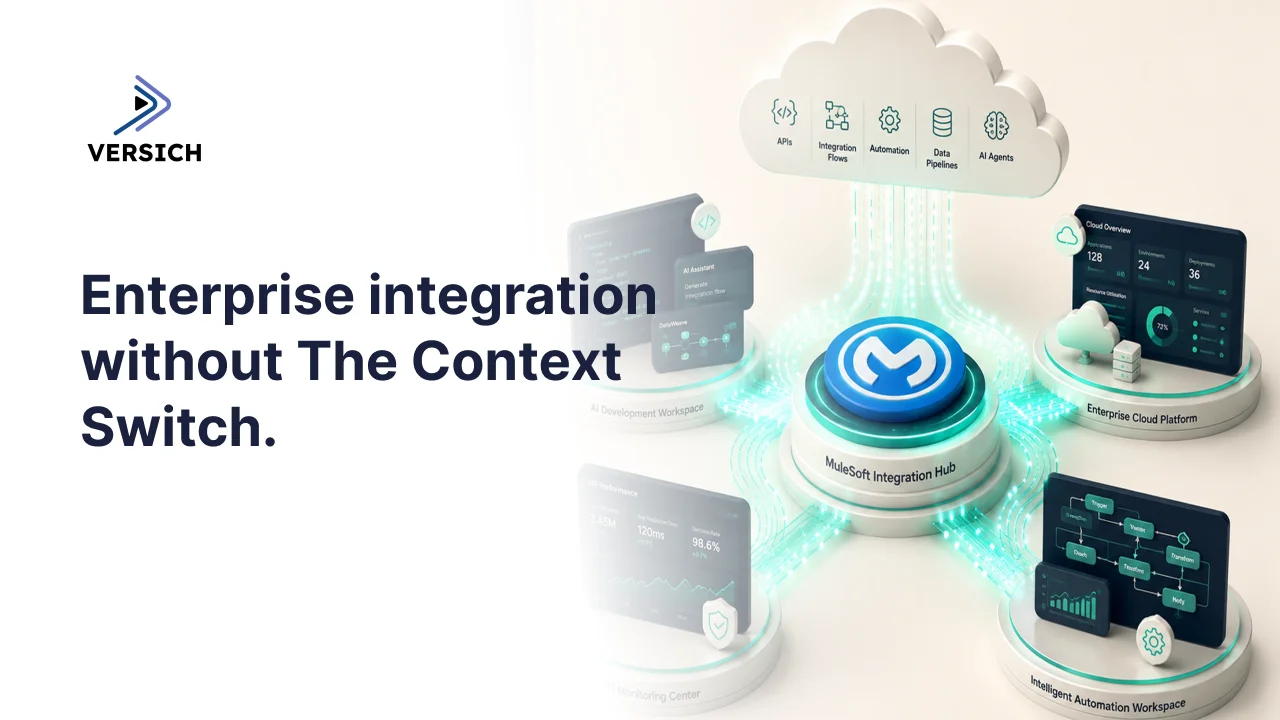
In software architecture, headless refers to separating backend capability from the frontend interface that traditionally provides access to it. Applied to MuleSoft, going headless means decoupling the platform's core functionality, including APIs, governance, monitoring, and runtime management, from the Anypoint Portal interface teams have historically used to access those capabilities.
The mechanism that enables this is the MuleSoft Platform MCP Server.
MCP stands for Model Context Protocol: an emerging standard that allows AI tools, developer environments, and autonomous agents to communicate directly with external platforms and services through a structured, permission-governed interface.
By implementing an MCP Server, MuleSoft becomes natively accessible from inside the environments where modern development work actually happens.
Claude Desktop. Cursor. Windsurf. VS Code.
A developer no longer needs to navigate to Anypoint Platform to check an API status, review a governance policy, or trigger a deployment. They can do all of that without leaving their primary workspace. And AI agents can do the same autonomously, within defined permission boundaries, without requiring human intervention for every platform interaction.
Why This Is an Architectural Shift, Not a Feature Update
It is tempting to frame headless MuleSoft as a developer experience improvement. It is that but framing it that way undersells what is actually happening.
This is a structural change in how integration platforms fit into the modern enterprise technology workflow. And it has three implications that go well beyond convenience.
Integration work gets faster without cutting corners
Every time a developer context-switches to access integration tooling there is a hidden time cost. Multiply that across a team, across a project, across a quarter and the accumulated friction becomes measurable. Removing that switching cost from the daily workflow keeps development velocity higher throughout the project lifecycle without compromising the governance and monitoring that enterprise integration requires.
AI agents become active participants in integration operations
This is the more significant implication. As organisations build agentic AI workflows where AI systems are not just generating suggestions but taking real actions with the ability for those agents to interact directly with enterprise integration infrastructure becomes a genuine architectural requirement.
An AI agent that can query API health, identify a failed integration flow, and trigger a remediation action without a human approving every step is a fundamentally different operational capability than an AI assistant that can only answer questions about the system.
Headless MuleSoft makes that second scenario architecturally possible in a way that maintains enterprise governance standards.
Governance does not get sacrificed for accessibility
The reasonable concern with opening platform access through AI tools and autonomous agents is security. The MCP Server architecture addresses this directly by maintaining the same role-based access controls and permission boundaries that govern traditional platform access.
Developers and agents access only what their assigned roles permit. The interface changes. The governance layer does not.
What This Means for Organisations Running MuleSoft Today
If your organisation is already running MuleSoft as part of your integration architecture, the headless shift is an evolution rather than a replacement. Your existing APIs, integration flows, and governance configurations remain intact. What changes is the surface area through which your team interacts with them and the range of actors, human and automated, who can do so.
The Broader Context: Why This Is Happening Now
Headless MuleSoft does not exist in isolation. It is part of a broader shift across enterprise software platforms toward AI-native accessibility.
In the same period that MuleSoft's MCP Server became available, SAP shipped a portfolio of autonomous AI agents embedded into S/4HANA workflows. Oracle launched agentic applications across Fusion finance and supply chain. Salesforce released significant updates to Agentforce.
Three of the largest enterprise software vendors on the planet are all moving in the same direction at the same time toward platforms where AI agents are not add-ons but active operational participants with defined roles, governance boundaries, and real-time access to enterprise data and processes.
MuleSoft going headless is Salesforce's answer to that same shift at the integration layer.
For enterprise organisations, the pattern here matters more than any individual product announcement. The architecture of enterprise software is being redesigned around the assumption that AI agents will be doing real work and not just assisting humans doing real work.
The integration layer is where that shift gets implemented in practice.
How Versich Approaches This
At Versich our integration practice is built around the conviction that implementation quality determines whether enterprise platforms deliver their theoretical value or fall short of it in practice.
Headless MuleSoft is a significant capability, but its value to any specific organisation depends entirely on how well the implementation maps to that organisation's actual workflows, governance requirements, and AI maturity.
Our approach to MuleSoft engagements has always been architecture-first. We begin by understanding how your systems are connected today, where the friction lives, and what the integration layer needs to support as the business scales. Headless capability and AI agent integration become part of that architectural conversation not afterthoughts bolted onto a standard implementation.
If your organisation is evaluating MuleSoft or looking to evolve an existing MuleSoft environment to take advantage of AI-native access, that is the conversation we are built for.