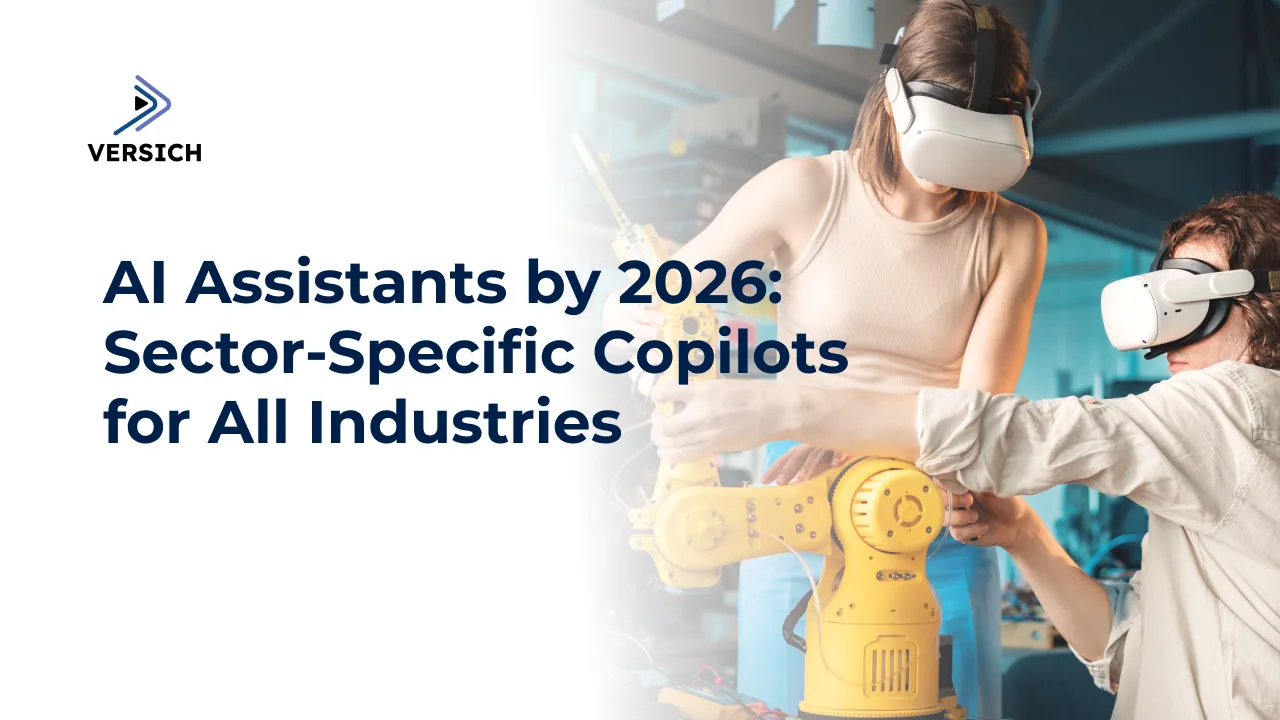
By 2026, sector-specific AI copilots will be integral to every industry. Early adopters will revolutionize productivity, spur innovation, and elevate customer service experiences. In contrast, those who hesitate may find themselves at a disadvantage in competitive landscapes. These intelligent and autonomous assistants symbolize not merely a trend but a transformative approach in organizational functionality and growth.
“At present, many companies declare themselves as AI-focused. This mirrors earlier claims of being mobile-first right after the iPhone App Store debut. But nowadays, no software firm identifies solely as a mobile entity because incorporating mobile applications has become essential. In the same way, it will soon be unthinkable for any product or service not to integrate AI capabilities,” states Sam Altman, co-founder and CEO of OpenAI. This transition is already evident, with 78% of organizations utilizing AI and 85% incorporating AI agents, or copilots, into their workflows. Companies are embracing agentic AI to enhance operational efficiency, and by 2026, nearly every sector-ranging from IT and telecom to healthcare and finance-will adopt this technology. “The competitive landscape is becoming more daunting, and organizations that fail to integrate AI and data to drive innovation will likely lag behind,” warns Paul Daugherty, Chief Technology and Innovation Officer at Accenture. Industries are prioritizing this technological shift for numerous reasons, including personalization, efficiency, speed, data-driven insights, and scalability. In this article, we’ll delve deeper into why AI copilots are becoming indispensable across sectors and how the adoption of agentic AI is transforming business operations.
Understanding AI Copilots
An AI copilot serves as a sophisticated software assistant, designed to aid you in making decisions, managing tasks, and optimizing workflows. By leveraging artificial intelligence, it automates mundane assignments, extracts insights from data, and proposes solutions, allowing users to concentrate on more complex responsibilities. Over time, these copilots enhance their functionality by learning from your interactions, resulting in increasingly personalized and effective support.
Core Features of Enterprise AI Copilots
The essential features of AI copilots are detailed below:
Decision Support: Facilitates quicker, smarter, and more informed decision-making.
Task Automation: Undertakes routine work, liberating employee time for essential tasks.
Intelligent Suggestions: Delivers insights and recommendations derived from data.
Learning & Adaptation: Continuously evolves by learning from user actions.
Data Analysis: Quickly processes extensive data sets to uncover valuable trends.
Personalization: Customizes outputs according to specific workflows or industry requirements.
Collaboration Support: Enhances team coordination and workflow management.
Error Reduction: Limits mistakes by providing accurate and consistent guidance.
Integration with Tools: Works harmoniously with existing software and systems.
Scalability: Effectively manages increasing workloads without necessitating additional personnel.
Mechanisms Behind AI Copilots
AI copilots operate by employing AI technologies to grasp tasks, evaluate data, and offer timely assistance. They utilize machine learning and natural language processing to provide recommendations, automate processes, and support smarter decision-making. By interacting with an AI copilot, it learns from your behavior, preferences, and historical data, refining its recommendations accordingly. Furthermore, its capability to integrate with existing software and systems enhances workflow efficiency and minimizes errors.
Reasons Industries Are Embracing AI Copilots
Industries are swiftly adopting AI copilots tailored to their sectors due to the substantial benefits they deliver. Here’s how:
Efficiency and Productivity: Vertical AI copilots automate tasks such as data entry and reporting, reducing manual labor and accelerating workflow automation, enabling teams to achieve greater results within shorter timeframes.
Informed Decision-Making: By analyzing real-time data and recognizing patterns that may elude human analysts, AI copilots facilitate quicker and more precise decision-making, which is essential in sectors like finance, healthcare, and IT where accuracy is paramount.
Enhanced Customer Experience: AI copilots offer personalized suggestions and promptly address customer inquiries, significantly improving service quality in retail, telecom, and banking industries.
Consistency and Error Minimization: By adeptly managing repetitive tasks, AI copilots lower human error rates while ensuring consistent quality throughout processes, demonstrating the critical role of automated industry AI.
Scalability: As organizations expand, they can swiftly scale AI solutions without increasing staff, making them perfect for rapidly growing companies.
Industry-Specific Applications of AI Copilots
The following are examples of how various sectors are utilizing AI copilots:
Healthcare
In healthcare, AI copilots are significantly enhancing efficiency and accuracy for healthcare professionals. An illustrative case is Penda Health’s AI clinical copilot, integrated into their electronic health records, which aided during 40,000 patient visits-leading to a 16% reduction in diagnostic errors and a 13% decrease in treatment mistakes, providing real-time alerts aligned with local medical guidelines.
Finance
The finance sector employs AI copilots to automate routine analyses and identify transaction anomalies. This practice boosts speed and accuracy in compliance measures and fraud detection. Financial firms utilize these tools for real-time data analytics to inform investment strategies and manage potential risks.
IT and Software Development
AI copilots are widely adopted in IT, assisting with tasks like coding, bug detection, and routine DevOps operations. Tools such as GitHub Copilot provide developers with immediate coding suggestions, automating testing processes which hasten product releases and enhance software quality.
Retail
In the retail sector, AI copilots enhance personalization in customer experiences by recommending products based on both browsing behaviors and purchase history. They also optimize inventory management and logistics. For instance, Zalando, a prominent German eCommerce retailer, employs a ChatGPT-driven virtual assistant that guides customers with product details and selections. This assistant offers tailored outfit suggestions based on seasonal trends, occasions, and personal preferences, thus enriching the shopping experience.
Preparing for Implementing Generative AI in Enterprise Workflows
Adopting generative AI within enterprise workflows requires strategic planning and a systematic approach. The goal is to discern how AI can boost efficiency and accuracy. A well-structured implementation ensures that AI solutions align with specific business needs and yield observable benefits.
Engage AI Consulting Services for Tailored Solutions
Every organization has its own workflows, data structures, and objectives. Collaborating with an AI development firm guarantees a personalized implementation strategy. Generative AI consultants can assist in pinpointing where generative AI can be the most effective without disrupting existing systems.
Collaborate with industry specialists who understand your business challenges.
Map current workflows to identify areas where generative AI can add value.
Ensure seamless assimilation with current tools and software.
Establish clear objectives and metrics for success pre-implementation.
Initiate with Pilot Projects
Begin with a phased strategy allowing you to test hypotheses and collect insights to fine-tune your approach. Launching pilot projects mitigates risks and fosters employee confidence. It’s wise to target a specific issue that AI can effectively address rather than executing a comprehensive rollout.
Select a limited project scope with identifiable, measurable results.
Conduct tests to evaluate AI accuracy, speed, and user interactions.
Utilize feedback for workflow enhancements before expanding to further areas.
Gradually broaden the scope while continuously monitoring outcomes and feedback from staff.
Monitor ROI and Optimize Processes
Regular assessment guarantees that AI investments are yielding the intended outcomes. Identify performance indicators relevant to your organization and consistently track advancements. Adjustments based on data-driven insights can refine models and enhance operational processes.
Establish KPIs like cost-effectiveness and customer satisfaction.
Gather data during both pilot and scaling phases to evaluate performance.
Continuously update AI models and workflows informed by actual usage.
Align any improvements with overarching business objectives.
Foster Workforce Adoption and Upskilling
The effectiveness of AI solutions declines if the workforce is not comfortable with them. Comprehensive training and support are crucial for ensuring teams recognize the benefits of AI and its role in enhancing productivity. Promoting employee engagement with AI through clear communication and ongoing learning integrates it smoothly into daily practices.
Offer training sessions tailored for various teams and functions.
Provide resources to assist users throughout their workflows.
Establish support systems for employees to resolve issues quickly.
Encourage a culture that views AI as an enhancement tool rather than a replacement.
Conclusion
AI copilots are set to become essential partners across various industries. Organizations leveraging them to optimize operations and enhance decision-making will uncover new avenues for revenue generation. Engaging AI consulting services equips companies to implement solutions that align with their unique workflows, while continuous integration facilitates ongoing improvements and adaptability. Companies that embrace AI copilots early will enhance operational efficiency and improve customer service, while those who delay may face challenges.