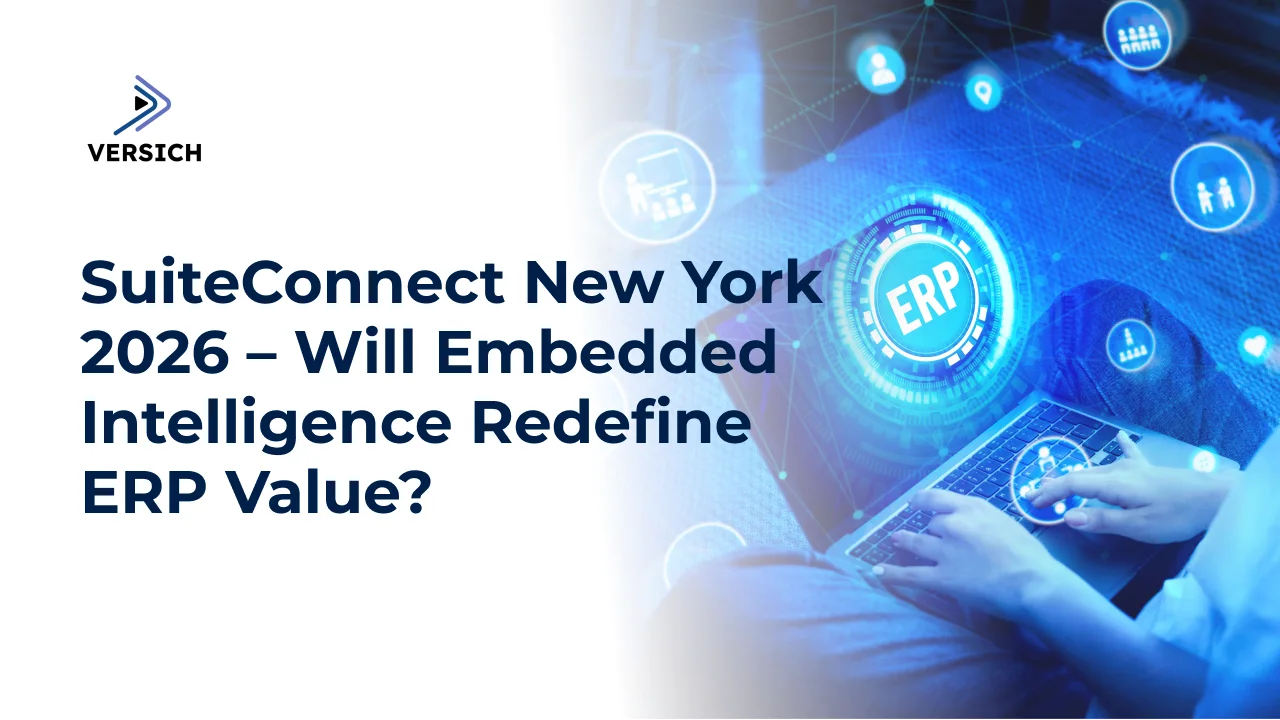
At SuiteConnect NYC, a clear message emerged from NetSuite’s latest announcements: artificial intelligence is no longer an add-on to enterprise resource planning, it is becoming the foundation of ERP value itself. With embedded intelligence now woven directly into finance, operations, and integration workflows, the ERP market is approaching a turning point. The question for enterprises is no longer whether AI belongs in ERP, but how deeply it is embedded into the systems that run the business.
NetSuite’s evolving strategy reflects a broader industry shift. ERP platforms are moving beyond digitizing workflows toward actively interpreting data, automating judgment-heavy tasks, and guiding business decisions in real time. This evolution has significant implications for ERP buyers, competitors, and the broader ecosystem.
Embedded Intelligence Signals a New Phase of ERP Automation
For years, ERP automation focused primarily on rules-based workflows automating approvals, routing transactions, and enforcing process consistency. NetSuite’s latest innovations suggest the market is entering a more advanced phase, where systems not only execute processes but also understand context, detect anomalies, and recommend actions.
New capabilities such as the Intelligent Close Manager and AI-driven bank transaction matching illustrate this transition. These tools embed generative AI and analytics directly into core financial processes like close management, reconciliation, and reporting. Instead of relying on manual reviews or after-the-fact analysis, finance teams can now identify risks, delays, and exceptions as they occur.
Equally important is the introduction of AI-generated report narratives and customer summaries. These features translate complex financial and operational data into plain-language insights, reducing dependence on technical specialists. For business users, this lowers the barrier to data-driven decision-making and accelerates response times across the organization.
This shift reflects growing customer demand for end-to-end automation that spans data capture, processing, analysis, and action all within a single platform.
Competitive Pressure Across the ERP Landscape
NetSuite’s approach raises the bar for established ERP vendors such as SAP, Microsoft, and Workday. While these providers have made significant investments in AI, many still depend on separate AI modules, partner ecosystems, or external analytics layers to deliver advanced intelligence.
By embedding AI directly into its unified cloud ERP, NetSuite reduces the friction associated with integrations, data movement, and user adoption. For mid-market and high-growth organizations in particular, this unified approach offers faster time-to-value and lower operational complexity.
For ERP buyers, the implication is clear: future platform evaluations will increasingly focus on how seamlessly AI is integrated into core business processes not simply on the availability of AI features. Embedded intelligence is becoming a baseline expectation rather than a differentiator.
Implications for Partners and the ERP Ecosystem
NetSuite’s strategy also reshapes the role of ecosystem partners, including independent software vendors (ISVs), consultants, and system integrators (SIs). As basic automation and data extraction become native ERP capabilities, partner value will shift toward higher-order services such as industry-specific extensions, advanced configuration, data strategy, and change management.
Rather than building custom automation from scratch, partners will need to focus on helping customers optimize AI-driven workflows, govern intelligent systems, and align automation with business outcomes. This evolution mirrors changes already underway in adjacent markets such as integration platforms and low-code development tools.
By embedding AI and low-code capabilities directly into its ERP environment, NetSuite is positioning itself as a platform for business-led transformation, reducing reliance on standalone automation or integration tools while expanding the influence of business users in process design.
AI-Driven, Low-Code Integration Changes the Rules
One of the most disruptive elements of NetSuite’s roadmap is the evolution of its Integration Platform. Traditionally, integration has been a technical bottleneck, dependent on scarce developer resources and complex middleware configurations. NetSuite’s new approach aims to democratize integration without sacrificing control.
Through a visual, low-code environment supported by AI-assisted mapping and natural language prompts, business analysts and process owners can now build, modify, and troubleshoot integrations with minimal technical expertise. This business-led automation model mirrors trends seen in platforms like Microsoft Power Platform and Workato, but with a critical advantage: direct access to ERP and financial data context.
Prebuilt adapters, AI-generated documentation, and intelligent error handling further reduce implementation time. For organizations struggling with integration backlogs, shadow IT, or slow project delivery, this capability could represent a significant operational advantage.
Governance, Security, and API Management at Enterprise Scale
While democratization is a key theme, NetSuite has also emphasized governance and security an essential balance for large and regulated enterprises. The NetSuite Integration Platform (NSIP) introduces centralized controls for automation, role-based access, audit trails, and real-time monitoring.
A unified API management layer provides end-to-end visibility into integrations, with proactive alerts and performance tracking. These capabilities rival those of established integration vendors such as MuleSoft and Boomi but are now delivered as part of a tightly integrated ERP ecosystem built on Oracle Cloud Infrastructure.
Additional features such as intelligent document processing and AI-powered data enrichment expand use cases into areas like automated order intake, procurement approvals, and exception handling. Together, these capabilities position NetSuite as more than an ERP system it becomes a hub for intelligent business orchestration.
The Economics of Embedded AI and the Road Ahead
As embedded intelligence becomes standard, ERP vendors will face increasing pressure to demonstrate measurable financial impact. Faster close cycles, reduced errors, improved compliance, and better cash visibility are compelling benefits, but customers will expect clear ROI to justify ongoing subscription costs.
The rise of agentic AI further complicates this equation. As organizations experiment with custom AI agents and alternative ways to access enterprise data, ERP vendors must ensure their platforms remain indispensable not just as systems of record, but as systems of insight and action.
NetSuite’s current trajectory suggests a strong understanding of this challenge. By embedding intelligence deeply into finance, operations, and integration workflows, the platform strengthens its position at the center of enterprise decision-making.
Conclusion
SuiteConnect NYC 2026 highlighted a pivotal moment for the ERP market. Embedded intelligence is no longer optional, and NetSuite’s latest innovations reflect a strategic bet that AI-driven automation and insight will define the next generation of ERP value.
For enterprises, this shift promises greater efficiency, agility, and accessibility to insights. For competitors and partners, it raises expectations and accelerates the pace of innovation. As embedded AI becomes the new baseline, the ERP platforms that succeed will be those that seamlessly connect data, intelligence, and action without adding complexity.
Disclosure:
Versich is an independent technology and research-focused organization. Analysis and opinions expressed in this article are those of our consultants and are based on publicly available information and industry experience