In NetSuite, the "Enable Features" section (under Setup > Company > Enable Features) includes several distinct intercompany options that manage how subsidiaries interact. The primary differences lie in the scope of automation-ranging from basic manual to fully automated to specialized transactional workflows
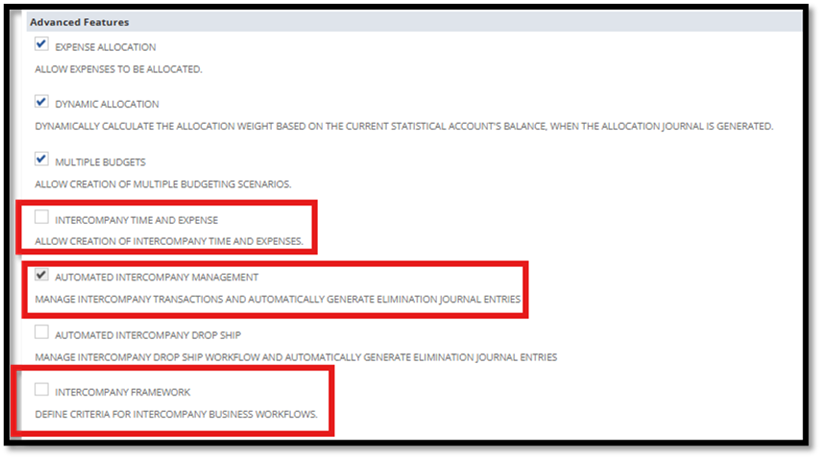
Here is the breakdown of the differences between Intercompany Features, Automated Intercompany Management, and Intercompany Time and Expense:
1. Intercompany Features (The Core Framework)
- What it does: This is the base-level setting that enables essential intercompany capabilities in NetSuite OneWorld.
- Key Functions: Allows for the creation of intercompany journal entries and records transactions (like invoices or journal entries) where the entities belong to different subsidiaries.
- Best for: Companies that need to record transactions between subsidiaries but are okay with manually managing the reconciliation and elimination at month-end
2. Automated Intercompany Management (The Automation Engine)
- What it does: This feature automates the "heavy lifting" of intercompany accounting, particularly the elimination process.
- Key Functions:
- Automated Elimination: Automatically creates elimination journal entries during the period close process to remove artificial profit and loss from consolidated books.
- Intercompany Sales/Purchase Orders: Allows for generating intercompany sales orders directly from intercompany purchase orders.
- Auto-Balancing: Automatically creates due-to/due-from balancing entries on multi-subsidiary journals.
- Best for: Companies with high-volume, regular intercompany transactions (e.g., Sales Order/Purchase Order pairs) that want to streamline period-end closing
3. Intercompany Time and Expense (The Specific Use Case)
- What it does: A specialized feature that allows employees in one subsidiary to record time or expenses against a customer or project belonging to a different subsidiary.
- Key Functions:
- Allows time and expense entries where employee/customer subsidiaries differ.
- Automatically creates "adjusting" intercompany journal entries to transfer charges (like costs) from the employee's subsidiary to the customer's subsidiary.
- Provides "Auto Adjust" functionality specifically for expense transactions.
- Best for: Professional services or project-based companies with shared resources across different subsidiaries.
Summary Table: Key Differences between Intercompany Features, Automated Intercompany Management and Intercompany Time and Expense
Feature | Primary Purpose | Key Benefit | Key Automation |
| Basic recording | Allows cross-subsidiary postings | Manual |
| Financial closing & AR/AP | Reduces manual reconciliation & eliminates profit | Auto-elimination & Order linking |
| Operational efficiency | Tracks shared staff time/costs across subs | Auto-adjusting entries for T&E |
Key Interdependence:
You can use Intercompany Time and Expense without Automated Intercompany Management, but if you want the most efficient setup, Automated Intercompany Management is usually used in conjunction with the basic Intercompany Features to automate the journal entries generated by the Intercompany Time and Expense feature